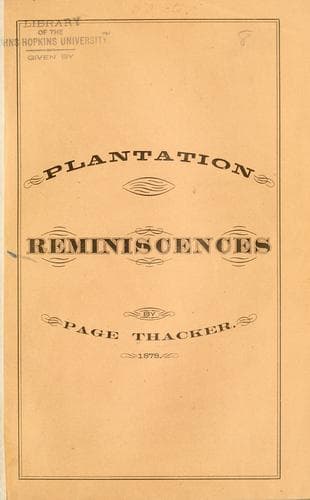
Plantation life; Virginia -- Social life and customs
"Yes," he used to say, "I staid with your grandpa ten years in
Congress, and all the time he was Secretary for President Jefferson. He
nuver give me a cross word, and I nuver saw your grandma the least out
of temper neither, but once, and that was at a dinner party 'we' give
in Washington, when the French Minister said something disrespectful
about the United States."
Often did he tell us: "The greatest pleasure I expect in heaven, is
seeing my old master." And sometimes, "I dream about my master and
mistress when I am sleep, and talk with them and see them so plain it
makes me so happy that I laugh out right loud."
This man was true and honest--a good Christian. Important trusts had
been confided to him. He frequently carried the carriage and horses to
Washington and Baltimore--a journey of two weeks--and sometimes sent to
carry a large sum of money to a distant county.
His wife, who had accompanied him in her youth to Washington, also
entertained us with gossip about the people of that day, and could
tell exactly the size and color of Mrs. Madison's slippers, how she
was dressed on certain occasions, "what beautiful manners she had,"
how Mr. Jefferson received master and mistress when "we" drove up to
Monticello, what room they occupied, &c.
Although my grand-father's death occurred thirty years before, the
negroes still remembered it with sorrow; and one of them, speaking of
it, said to me, "Ah, little mistess, 'twas a sorrowful day when de news
come from Washington dat our good, kind master was dead. A mighty wail
went up from dis plantation, for we know'd we had loss our bes friend."
The only negro on the place who did not evince an interest in the white
family was a man ninety years old, who, forty years before, announced
his intention of not working any longer--although still strong and
athletic--because, he said, "the estate had done come down so he hadn't
no heart to work no longer." He remembered, he said, "when thar was
three and four hundred black folks, but sence de British debt had to be
paid over by his old master, and de Macklenbug estate had to be sold,
he hadn't had no heart to do nothin' sence." And "he hadn't seen no
_real_ fine white folks--what _he_ called real fine white folks--sence
he come from Macklenbug." All his interest in life having expired with
an anterior generation; we were in his eyes but a poor set, and he
refused to have anything to do with us. Not being compelled to work,
he passed his life principally in the woods, wore a rabbit-skin cap
and a leather apron. Having lost interest in, and connection with the
white family, he gradually relapsed into a state of barbarism, refusing
towards the end of his life to sleep in his bed, preferring a hard
bench in his cabin, upon which he died.
Another very old man remembered something of his father, who had come
from Africa; and when we asked him to tell us what he remembered of his
father's narrations, would say:
Public-domain text, read in full here on John Shaqi.
Reviews
Reviews
No reviews yet
Be the first to share your thoughts on this work.
Join the Discussion
Join the discussion
Sign in to leave a comment or review.
Sign InorCreate an account