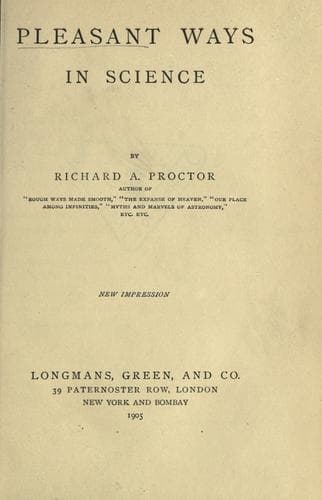
Pleasant Ways in ScienceProctor, Richard A. (Richard Anthony)
Science
Pleasant Ways in Science
Proctor, Richard A. (Richard Anthony)
Science
not hitherto been employed) to the dilution of a dense liquid in which
solid masses have been floating: the more we increase the quantity of
the liquid in diluting it with water, the more transparent it becomes,
but the solid masses in it are not changed, so that we only have to
dilute the liquid sufficiently to see these masses. _But_ if there were
in the interstices of the solid masses particles of some substance
which dissolved in the water, we should not recognize the presence of
this substance by any increase in its visibility; for the very same
process which thinned the liquid would thin this soluble substance in
the same degree. In like manner, by dispersing and correspondingly
weakening the sun’s light more and more, we can recognize the light of
the gaseous matter in the prominences, for this is not weakened; but if
the prominences also contain matter in the solid or liquid form (that
is, drops or crystals), the spectroscopic method will not indicate the
presence of such matter, for the spectrum of matter of this sort will
be weakened by dispersion in precisely the same degree that the solar
spectrum itself is weakened.
It is easy to see how the evidence of the presence of any element
which behaved in this way would be weakened, if we consider what would
happen in the case of our own earth, according as the air were simply
moist but without clouds, or loaded with cumulus masses but without
cirrus clouds, or loaded with cirrus clouds. For although there is not
in the case of the earth a central glowing mass like the sun’s, on
whose rainbow-tinted spectrum the dark lines caused by the absorptive
action of our atmosphere could be seen by the inhabitant of some
distant planet studying the earth from without, yet the sun’s light
reflected from the surface of the earth plays in reality a similar
part. It does not give a simple rainbow-tinted spectrum; for, being
sunlight, it shows all the dark lines of the solar spectrum: but the
addition of new dark lines to these, in consequence of the absorptive
action of the earth’s atmosphere, could very readily be determined. In
fact, we do thus recognize in the spectra of Mars, Venus, and other
planets, the presence of aqueous vapour in their atmosphere, despite
the fact that our own air, containing also aqueous vapour, naturally
renders so much the more difficult the detection of that vapour in the
atmosphere of remote planets necessarily seen through our own air.
Now, a distant observer examining the light of our own earth on a day
when, though the air was moist, there were no clouds, would have ample
evidence of the presence of the vapour of water; for the light which he
examined would have gone twice through our earth’s atmosphere, from its
outermost thinnest parts to the densest layers close to the surface,
then back again through the entire thickness of the air. But if the
air were heavily laden with cumulus clouds (without any cirrus clouds
Public-domain text, read in full here on John Shaqi.
Reviews
Reviews
No reviews yet
Be the first to share your thoughts on this work.
Join the Discussion
Join the discussion
Sign in to leave a comment or review.
Sign InorCreate an account