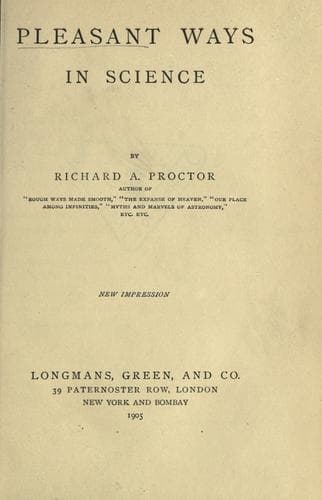
Pleasant Ways in ScienceProctor, Richard A. (Richard Anthony)
Science
Pleasant Ways in Science
Proctor, Richard A. (Richard Anthony)
Science
There is another consideration, which, so far as I know, has not
hitherto received much attention, but should certainly be taken into
account in the attempt to interpret the real meaning of the solar
spectrum. Some of the metals which are vaporized by the sun’s heat
below the photosphere may become liquid or even solid at or near the
level of the photosphere. Even though the heat at the level of the
photosphere may be such that, under ordinary conditions of pressure and
so forth, such metals would be vaporous, the enormous pressure which
must exist not far below the level of the photosphere may make the
heat necessary for complete vaporization far greater than the actual
heat at that level. In that case the vapour will in part condense into
liquid globules, or, if the heat is considerably less than is necessary
to keep the substance in the form of vapour, then it may in part be
solidified, the tiny globules of liquid metal becoming tiny crystals
of solid metal. We see both conditions fulfilled within the limits of
our own air in the case of the vapour of water. Low down the water
is present in the air (ordinarily) in the form of pure vapour; at a
higher level the vapour is condensed by cold into liquid drops forming
visible clouds (cumulus clouds), and yet higher, where the cold is
still greater, the minute water-drops turn into ice-crystals, forming
those light fleecy clouds called cirrus clouds by the meteorologist.
Now true clouds of either sort may exist in the solar atmosphere even
above that photospheric level which forms the boundary of the sun we
see. It may be said that the spectroscope, applied to examine matter
outside the photosphere, has given evidence only of vaporous cloud
masses. The ruddy prominences which tower tens of thousands of miles
above the surface of the sun, and the sierra (or as it is sometimes
unclassically called, the chromosphere) which covers usually the
whole of the photosphere to a depth of about eight thousand miles,
show only, under spectroscopic scrutiny, the bright lines indicating
gaseity. But though this is perfectly true, it is also true that we
have not here a particle of evidence to show that clouds of liquid
particles, and of tiny crystals, may not float over the sun’s surface,
or even that the ruddy clouds shown by the spectroscope to shine with
light indicative of gaseity may not also contain liquid and crystalline
particles. For in point of fact, the very principle on which our
recognition of the bright lines depends involves the inference that
matter whose light would _not_ be resolved into bright lines would
not be recognizable at all. The bright lines are seen, because by
means of a spectroscope we can throw them far apart, without reducing
their lustre, while the background of rainbow-tinted spectrum has its
various portions similarly thrown further apart and correspondingly
weakened. One may compare the process (the comparison, I believe, has
Public-domain text, read in full here on John Shaqi.
Reviews
Reviews
No reviews yet
Be the first to share your thoughts on this work.
Join the Discussion
Join the discussion
Sign in to leave a comment or review.
Sign InorCreate an account