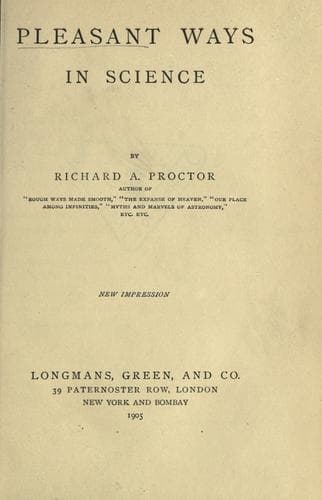
Pleasant Ways in ScienceProctor, Richard A. (Richard Anthony)
Science
Pleasant Ways in Science
Proctor, Richard A. (Richard Anthony)
Science
In 1840, Schönbein began to inquire into the cause of this peculiar
odour. He presently found that it is due to some change in the oxygen;
and that it can be produced in many ways. Of these, the simplest, and,
in some respects, the most interesting, is the following:—“Take sticks
of common phosphorus, scrape them until they have a metallic lustre,
place them in this condition under a large bell-jar, and half-cover
them with water. The air in the bell-jar is soon charged with ozone,
and a large room can readily be supplied with ozonized air by this
process.”
Schönbein set himself to inquire into the properties of this new gas,
and very interesting results rewarded his researches. It became quite
clear, to begin with, that whatever ozone may be, its properties are
perfectly distinct from those of oxygen. Its power of oxidizing or
rusting metals, for example, is much greater than that which oxygen
possesses. Many metals which oxygen will not oxidize at all, even
when they are at a high temperature, submit at once to the influence
of ozone. But the power of ozone on other substances than metals is
equally remarkable. Dr. Richardson states that, when air is so ozonized
as to be only respirable for a short time, its destructive power is
such that gutta-percha and india-rubber tubings are destroyed by merely
conveying it.
The bleaching and disinfecting powers of ozone are very striking.
Schönbein was at first led to associate them with the qualities of
chlorine gas; but he soon found that they are perfectly distinct.
It had not yet been shown whether ozone was a simple or a compound
gas. If simple, of course it could be but another form of oxygen. At
first, however, the chances seemed against this view; and there were
not wanting skilful chemists who asserted that ozone was a compound of
the oxygen of the air with the hydrogen which forms an element of the
aqueous vapour nearly always present in the atmosphere.
It was important to set this question at rest. This was accomplished by
the labours of De la Rive and Marignac, who proved that ozone is simply
another form of oxygen.
Here we touch on a difficult branch of modern chemical research. The
chemical elements being recognized as the simplest forms of matter,
it might be supposed that each element would be unchangeable in its
nature. That a compound should admit of change, is of course a thing to
be expected. If we decompose water, for instance, into its component
elements, oxygen and hydrogen, we may look on these gases as exhibiting
water to us in another form. And a hundred instances of the sort might
be adduced, in which, either by separating the elements of a compound,
or by re-arranging them, we obtain new forms of matter without any real
change of substance. But with an element, the case, one would suppose,
should be different.
Public-domain text, read in full here on John Shaqi.
Reviews
Reviews
No reviews yet
Be the first to share your thoughts on this work.
Elsewhere in the archive
Join the Discussion
Join the discussion
Sign in to leave a comment or review.
Sign InorCreate an account