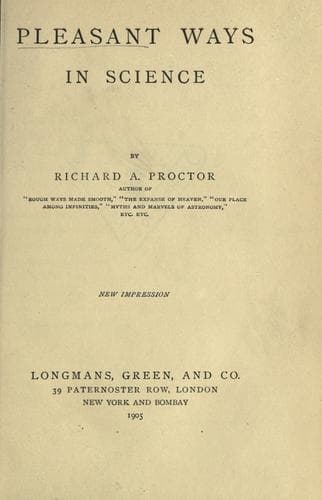
Pleasant Ways in ScienceProctor, Richard A. (Richard Anthony)
Science
Pleasant Ways in Science
Proctor, Richard A. (Richard Anthony)
Science
And now all the facts which had before seemed obscure were accounted
for. It had been noticed that metallic plates were often dry when
grass or wood was copiously moistened. Now, we know that metals part
unwillingly with their heat by radiation, and therefore the temperature
of a metal plate exposed in the open air is considerably higher than
that of a neighbouring piece of wood. For a similar reason, dew is
more freely deposited on grass than on gravel. Glass, again, is a
good radiator, so that dew is freely deposited on glass objects,—a
circumstance which is very annoying to the telescopist. The remedy
employed is founded on Wells’ observations—a cylinder of tin or card,
called a dew-cap, is made to project beyond the glass, and thus to act
as a screen, and prevent radiation.
We can now also interpret the effects of a clear sky. Clouds act the
part of screens, and check the emission of radiant heat from the earth.
This fact has been noticed before, but misinterpreted, by Gilbert White
of Selborne. “I have often observed,” he says, “that cold seems to
descend from above; for when a thermometer hangs abroad on a frosty
night, the intervention of a cloud shall immediately raise the mercury
ten degrees, and a clear sky shall again compel it to descend to its
former gauge.” Another singular mistake had been made with reference
to the power which clouds possess of checking the emission of radiant
heat. It had been observed that on moonlit nights the eyes are apt to
suffer in a peculiar way, which has occasionally brought on temporary
blindness. This had been ascribed to the moon’s influence, and the term
moon-blindness had therefore been given to the affection. In reality,
the moon has no more to do with this form of blindness than the stars
have to do with the formation of dew. The absence of clouds from the
air is the true cause of the mischief. There is no sufficient check
to the radiation of heat from the eyeballs, and the consequent chill
results in temporary loss of sight, and sometimes even in permanent
injury.
Since clouds possess this important power, it is clear that while they
are present in the air there can never be a copious formation of dew,
which requires, as we have seen, a considerable fall in the temperature
of the air around the place of deposition. When the air is clear,
however, radiation proceeds rapidly, and therefore dew is freely formed.
Public-domain text, read in full here on John Shaqi.
Reviews
Reviews
No reviews yet
Be the first to share your thoughts on this work.
Elsewhere in the archive
Join the Discussion
Join the discussion
Sign in to leave a comment or review.
Sign InorCreate an account