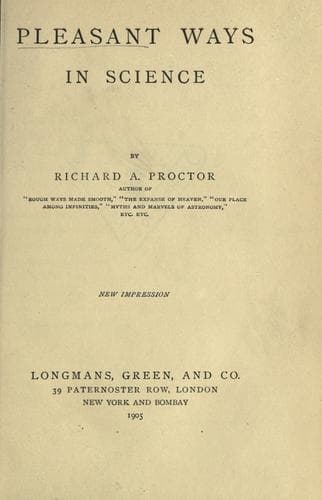
Pleasant Ways in ScienceProctor, Richard A. (Richard Anthony)
Science
Pleasant Ways in Science
Proctor, Richard A. (Richard Anthony)
Science
In conclusion, we should wish to point out the important preservative
influence exercised during the formation of dew. If the heat which is
radiated from the earth, or from objects upon it, during a clear night,
were not repaired in any way, the most serious injury would result to
vegetation. For instance, if the sun raised no vapour during the day,
so that when night came on the air was perfectly dry, and thus the
radiant heat passed away into celestial space without compensation, not
a single form of vegetation could retain its life during the bitter
cold which would result. But consider what happens. The sun’s heat,
which has been partly used up during the day in supplying the air
with aqueous vapour, is gradually given out as this vapour returns to
the form of water. Thus the process of refrigeration is effectually
checked, and vegetation is saved from destruction. There is something
very beautiful in this. During the day, the sun seems to pour forth his
heat with reckless profusion, yet all the while it is being silently
stored up; during the night, again, the earth seems to be radiating
her heat too rapidly into space, yet all the while a process is going
on by which the loss of heat is adequately compensated. Every particle
of dew which we brush from the blades of grass, as we take our morning
rambles, is an evidence of the preservative action of nature.
_THE LEVELLING POWER OF RAIN._
It has been recognized, ever since geology has become truly a science,
that the two chief powers at work in remodelling the earth’s surface,
are fire and water. Of these powers one is in the main destructive, and
the other preservative. Were it not for the earth’s vulcanian energies,
there can be no question that this world would long since have been
rendered unfit for life,—at least of higher types than we recognize
among sea creatures. For at all times igneous causes are at work,
levelling the land, however slowly; and this not only by the action
of sea-waves at the border-line between land and water, but by the
action of rain and flood over inland regions. Measuring the destructive
action of water by what goes on in the lifetime of a man, or even
during many successive generations, we might consider its effects very
slight, even as on the other hand we might underrate the effects of the
earth’s internal fires, were we to limit our attention to the effects
of upheaval and of depression (not less preservative in the long run)
during a few hundreds or thousands of years. As Lyell has remarked in
his “Principles of Geology,” “our position as observers is essentially
unfavourable when we endeavour to estimate the nature and magnitude of
the changes now in progress. As dwellers on the land, we inhabit about
a fourth part of the surface; and that portion is almost exclusively
a theatre of decay, and not of reproduction. We know, indeed, that
new deposits are annually formed in seas and lakes, and that every
Public-domain text, read in full here on John Shaqi.
Reviews
Reviews
No reviews yet
Be the first to share your thoughts on this work.
Elsewhere in the archive
Join the Discussion
Join the discussion
Sign in to leave a comment or review.
Sign InorCreate an account