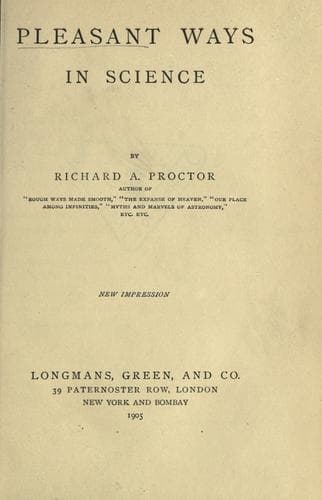
Pleasant Ways in ScienceProctor, Richard A. (Richard Anthony)
Science
Pleasant Ways in Science
Proctor, Richard A. (Richard Anthony)
Science
year some new igneous rocks are produced in the bowels of the earth,
but we cannot watch the progress of their formation; and as they are
only present to our minds by the aid of reflection, it requires an
effort both of the reason and the imagination to appreciate duly their
importance.” But that they are actually of extreme importance, that in
fact all the most characteristic features of our earth at present are
due to the steady action of these two causes, no geologist now doubts.
I propose now to consider one form in which the earth’s aqueous
energies effect the disintegration and destruction of the land. The sea
destroys the land slowly but surely, by beating upon its shores and by
washing away the fragments shaken down from cliffs and rocks, or the
more finely divided matter abstracted from softer strata. In this work
the sea is sometimes assisted by the other form of aqueous energy—the
action of rain. But in the main, the sea is the destructive agent by
which shore-lines are changed. The other way in which water works the
destruction of the land affects the interior of land regions, or only
affects the shore-line by removing earthy matter from the interior of
continents to the mouths of great rivers, whence perhaps the action of
the sea may carry it away to form shoals and sandbanks. I refer to the
direct and indirect effects of the downfall of rain. All these effects,
without a single exception, tend to level the surface of the earth. The
mountain torrent whose colour betrays the admixture of earthy fragments
is carrying those fragments from a higher to a lower level. The river
owes its colour in like manner to earth which it is carrying down to
the sea level. The flood deposits in valleys matter which has been
withdrawn from hill slopes. Rainfall, acts, however, in other ways, and
sometimes still more effectively. The soaked slopes of great hills give
way, and great landslips occur. In winter the water which has drenched
the land freezes, in freezing expands, and then the earth crumbles and
is ready to be carried away by fresh rains; or when dry, by the action
even of the wind alone. Landslips, too, are brought about frequently in
the way, which are even more remarkable than those which are caused by
the unaided action of heavy rainfalls.
Public-domain text, read in full here on John Shaqi.
Reviews
Reviews
No reviews yet
Be the first to share your thoughts on this work.
Elsewhere in the archive
Join the Discussion
Join the discussion
Sign in to leave a comment or review.
Sign InorCreate an account