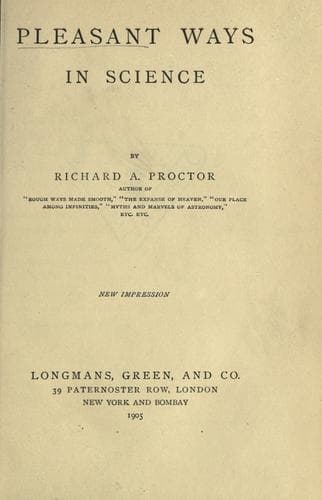
Pleasant Ways in ScienceProctor, Richard A. (Richard Anthony)
Science
Pleasant Ways in Science
Proctor, Richard A. (Richard Anthony)
Science
The most energetic action of aqueous destructive forces is seen when
water which has accumulated in the higher regions of some mountain
district breaks its way through barriers which have long restrained it,
and rushes through such channels as it can find or make for itself into
valleys and plains at lower levels. Such catastrophes are fortunately
not often witnessed in this country, nor when seen do they attain the
same magnitude as in more mountainous countries. It would seem, indeed,
as though they could attain very great proportions only in regions
where a large extent of mountain surface lies above the snow-line.
The reason why in such regions floods are much more destructive than
elsewhere will readily be perceived if we consider the phenomena of one
of these terrible catastrophes.
Take, for instance, the floods which inundated the plains of Martigny
in 1818. Early in that year it was found that the entire valley of the
Bagnes, one of the largest side-valleys of the great valley of the
Rhône, above Geneva, had been converted into a lake through the damming
up of a narrow outlet by avalanches of snow and ice from a loftier
glacier overhanging the bed of the river Dranse. The temporary lake
thus formed was no less than half a league in length, and more than
200 yards wide, its greatest depth exceeding 200 feet. The inhabitants
perceived the terrible effects which must follow when the barrier
burst, which it could not fail to do in the spring. They, therefore,
cut a gallery 700 feet long through the ice, while as yet the water
was at a moderate height. When the waters began to flow through this
channel, their action widened and deepened it considerably. At length
nearly half the contents of the lake were poured off. Unfortunately,
as the heat of the weather increased, the middle of the barrier slowly
melted away, until it became too weak to withstand the pressure of
the vast mass of water. Suddenly it gave way; and so completely that
all the water in the lake rushed out in half an hour. The effects of
this tremendous outrush of the imprisoned water were fearful. “In
the course of their descent,” says one account of the catastrophe,
“the waters encountered several narrow gorges, and at each of these
they rose to a great height, and then burst with new violence into the
next basin, sweeping along forests, houses, bridges, and cultivated
land.” It is said by those who witnessed the passage of the flood at
various parts of its course, that it resembled rather a moving mass
of rock and mud than a stream of water. “Enormous masses of granite
were torn out of the sides of the valleys, and whirled for hundreds
of yards along the course of the flood.” M. Escher the engineer tells
us that a fragment thus whirled along was afterwards found to have a
circumference of no less than sixty yards. “At first the water rushed
on at a rate of more than a mile in three minutes, and the whole
distance (forty-five miles) which separates the Valley of Bagnes from
Public-domain text, read in full here on John Shaqi.
Reviews
Reviews
No reviews yet
Be the first to share your thoughts on this work.
Elsewhere in the archive
Join the Discussion
Join the discussion
Sign in to leave a comment or review.
Sign InorCreate an account