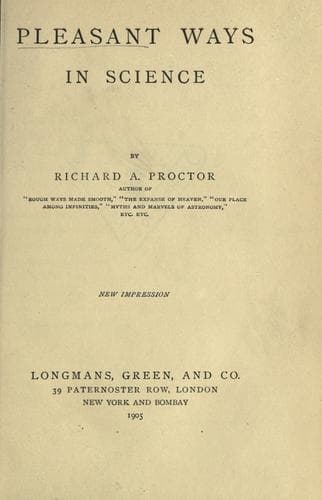
Pleasant Ways in ScienceProctor, Richard A. (Richard Anthony)
Science
Pleasant Ways in Science
Proctor, Richard A. (Richard Anthony)
Science
Now there are some terrestrial phenomena which we might expect to
respond in greater or less degree to the sun’s changes of condition
with respect to spots. We cannot doubt that the emission both of light
and of heat is affected by the presence of spots. It is not altogether
clear in what way the emission is affected. We cannot at once assume
that because the spots are dark the quantity of sunlight must be less
when the spots are numerous; for it may well be that the rest of the
sun’s surface may at such times be notably brighter than usual, and the
total emission of light may be greater on the whole instead of less.
Similarly of the emission of heat. It is certain that when there are
many spots the surface of the sun is far less uniform in brightness
than at other times. The increase of brightness all round the spots is
obvious to the eye when the sun’s image, duly enlarged, is received
upon a screen in a darkened room. Whether the total emission of light
is increased or diminished has not yet been put to the test. Professor
Langley, of the Alleghany Observatory, near Pittsburg, U.S., has
carefully measured the diminution of the sun’s emission of light and
heat on the assumption that the portion of the surface not marked by
spots remains unchanged in lustre. But until the total emission of
light and heat at the times of maximum and minimum has been measured,
without any assumption of the kind, we cannot decide the question.
More satisfactory would seem to be the measurements which have been
made by Professor Piazzi Smyth, at Edinburgh, and later by the
Astronomer Royal at Greenwich, into the underground temperature of
the earth. By examining the temperature deep down below the surface,
all local and temporary causes of change are eliminated, and causes
external to the earth can alone be regarded as effective in producing
systematic changes. “The effect is very slight,” I wrote a few years
ago, “indeed barely recognizable. I have before me as I write Professor
Smyth’s sheet of the quarterly temperatures from 1837 to 1869 at
depths of 3, 6, 12, and 24 French feet. Of course the most remarkable
feature, even at the depth of 24 feet, is the alternate rise and fall
with the seasons. But it is seen that, while the range of rise and fall
remains very nearly constant, the crests and troughs of the waves lie
at varying levels.” After describing in the essay above referred to,
which appears in my “Science Byways,” the actual configuration of the
curves of temperature both for seasons and for years, and the chart in
which the sun-spot waves and the temperature waves are brought into
comparison, I was obliged to admit that the alleged association between
the sun-spot period and the changes of underground temperature did
not seem to me very clearly made out. It appears, however, there is a
slight increase of temperature at the time when the sun-spots are least
numerous.
Public-domain text, read in full here on John Shaqi.
Reviews
Reviews
No reviews yet
Be the first to share your thoughts on this work.
Join the Discussion
Join the discussion
Sign in to leave a comment or review.
Sign InorCreate an account