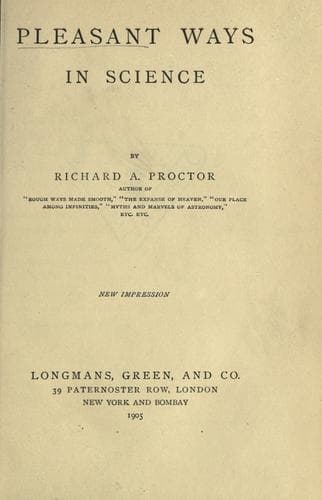
Pleasant Ways in ScienceProctor, Richard A. (Richard Anthony)
Science
Pleasant Ways in Science
Proctor, Richard A. (Richard Anthony)
Science
position, is in such complete unison with any changes that may
arise from oscillations in the amount of solar radiation, and their
effects upon the velocity and direction of the vapour-bearing winds,
that a careful study of it cannot fail to discover meteorological
periodicities in close connection with corresponding periods of solar
disturbance.” So, indeed, it would seem.
The hope that famines may be abated, or, at least, some of their most
grievous consequences forestalled by means of solar observatories, does
not appear very clearly made out. Rather it would seem that the proper
thing to do is to investigate the meteorological records of different
Indian regions, and consider the resulting evidence of cyclic changes
without any special reference to sun-spots; for if sun-spots may cause
drought in one place, heavy rainfall in another, winds here and calms
there, it seems conceivable that the effects of sun-spots may differ at
different times, as they manifestly do in different places.
Let us turn, however, from famines to shipwrecks. Perhaps, if we admit
that cyclones are more numerous, and blow more fiercely, and range
more widely, even though it be over one large oceanic region only, in
the sun-spot seasons than at other times, we may be assured, without
further research, that shipwrecks will, on the whole, be more numerous
near the time of sun-spot maxima than near the time of sun-spot minima.
The idea that this may be so was vaguely shadowed forth in a poem of
many stanzas, called “The Meteorology of the Future: a Vision,” which
appeared in _Nature_ for July 5, 1877. I do not profess to understand
precisely what the object of this poem may have been-—I mean, whether
it is intended to support or not the theory that sun-spots influence
the weather. Several stanzas are very humorous, but the object of the
humour is not manifest. The part referred to above is as follows:—Poor
Jack lies at the bottom of the sea in 1881, and is asked in a spiritual
way various questions as to the cause of his thus coming to grief. This
he attributed to the rottenness of the ship in which he sailed, to
the jobbery of the inspector, to the failure of the system of weather
telegraphing, and so forth. But, says the questioner, there was one
“In fame to none will yield,
He led the band who reaped renown
On India’s famine field.
“Was he the man to see thee die?
Thou wilt not tax him—come?
The dead man groaned—‘_I met my death
Through a sun-spot maximum_.’”
Public-domain text, read in full here on John Shaqi.
Reviews
Reviews
No reviews yet
Be the first to share your thoughts on this work.
Join the Discussion
Join the discussion
Sign in to leave a comment or review.
Sign InorCreate an account