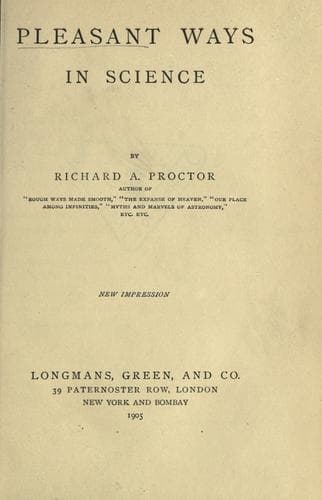
Pleasant Ways in ScienceProctor, Richard A. (Richard Anthony)
Science
Pleasant Ways in Science
Proctor, Richard A. (Richard Anthony)
Science
The advocates of the doctrine of sun-spot influence—or, perhaps
it would be more correct to say, the advocates of the endowment of
sun-spot research—think differently on these and other points. Each
one of the somewhat doubtful relations discussed above is constantly
referred to by them as a demonstrated fact, and a demonstrative proof
of the theory they advocate. For instance, Mr. Lockyer, in referring to
Meldrum’s statistical researches into the frequency of cyclones, does
not hesitate to assert that according to these researches “the whole
question of cyclones is merely a question of solar activity, and that
if we wrote down in one column the number of cyclones in any given
year, and in another column the number of sun-spots in any given year,
there will be a strict relation between them—many sun-spots, many
hurricanes; few sun-spots, few hurricanes.” ... And again, “Mr. Meldrum
has since found” (not merely “has since found reason to believe,” but
definitely, “has since found”) “that what is true of the storms which
devastate the Indian Ocean is true of the storms which devastate the
West Indies; and on referring to the storms of the Indian Ocean, Mr.
Meldrum points out that at those years where we have been quietly
mapping the sun-spot maxima, the harbours were filled with wrecks, and
vessels coming in disabled from every part of the Indian Ocean.” Again,
Mr. Balfour Stewart accepts Mr. Jeula’s statistics confidently as
demonstrating that there are most shipwrecks during periods of maximum
solar activity. Nor are the advocates of the new method of prediction
at all doubtful as to the value of these relations in affording the
basis of a system of prediction. They do not tell us precisely _how_ we
are to profit by the fact, if fact it is, that cyclones and shipwrecks
mark the time of maximum solar maculation, and droughts and famine the
time of minimum. “If we can manage to get at these things,” says Mr.
Lockyer, “the power of prediction, that power which would be the most
useful one in meteorology, if we could only get at it, would be within
our grasp.” And Mr. Balfour Stewart, in a letter to the _Times_, says,
“If we are on the track of a discovery which will in time enable
us to foretell the cycle of droughts, public opinion should demand
that the investigation be prosecuted with redoubled vigour and under
better conditions. If forewarned be forearmed, then such research will
ultimately conduce to the saving of life both at times of maximum and
minimum sun-spot frequency.”
Public-domain text, read in full here on John Shaqi.
Reviews
Reviews
No reviews yet
Be the first to share your thoughts on this work.
Join the Discussion
Join the discussion
Sign in to leave a comment or review.
Sign InorCreate an account