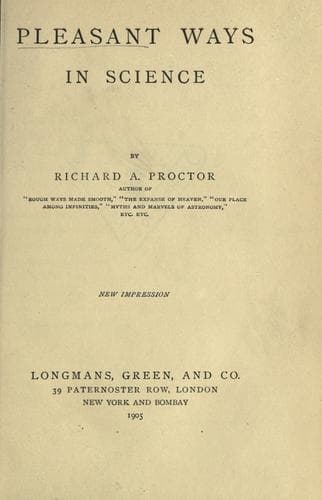
Pleasant Ways in ScienceProctor, Richard A. (Richard Anthony)
Science
Pleasant Ways in Science
Proctor, Richard A. (Richard Anthony)
Science
Supposing even it were not only proved that sun-spots exert such and
such effects, but that this knowledge can avail to help us to measures
of special precaution, how is the study of the sun going to advance
our knowledge? In passing, let it be remarked that already an enormous
number of workers are engaged in studying the sun in every part of
the world. The sun is watched on every fine day, in every quarter of
the earth, with the telescope, analyzed with the spectroscope, his
prominences counted and measured, his surface photographed, and so
forth. What more ought to be or could be done? But that is not the main
point. If more could be done, what could be added to our knowledge
which would avail in the way of prediction? “At present,” says Mr.
Balfour Stewart, “the problem has not been pursued on a sufficiently
large scale or in a sufficient number of places. If the attack is to
be continued, the skirmishers should give way to heavy guns, and these
should be brought to bear without delay now that the point of attack is
known.” In other words, now that we know, according to the advocates
of these views, that meteorological phenomena follow roughly the great
solar-spot period, we should prosecute the attack in this direction,
in order to find out—what? Minor periods, perhaps, with which
meteorological phenomena may still more roughly synchronize. Other such
periods are already known with which meteorological phenomena have
never yet been associated. New details of the sun’s surface? No one has
yet pretended that any of the details already known, except the spots,
affect terrestrial weather, and the idea that peculiarities so minute
as hitherto to have escaped detection can do so, is as absurd, on the
face of it, as the supposition that minute details in the structure
of a burning coal, such details as could only be detected by close
scrutiny, can affect the general quality and effects of the heat
transmitted by the coal, as part of a large fire, to the further side
of a large room.
Lastly, I would urge this general argument against a theory which seems
to me to have even less to recommend it to acceptance than the faith
in astrology.[8] _If it requires, as we are so strongly assured, the
most costly observations, the employment of the heaviest guns (and
“great guns” are generally expensive), twenty or thirty years of time,
and the closest scrutiny and research, to prove that sun-spots affect
terrestrial relations in a definite manner, effects so extremely
difficult to demonstrate cannot possibly be important enough to be
worth predicting._
_NEW WAYS OF MEASURING THE SUN’S DISTANCE._
Public-domain text, read in full here on John Shaqi.
Reviews
Reviews
No reviews yet
Be the first to share your thoughts on this work.
Join the Discussion
Join the discussion
Sign in to leave a comment or review.
Sign InorCreate an account