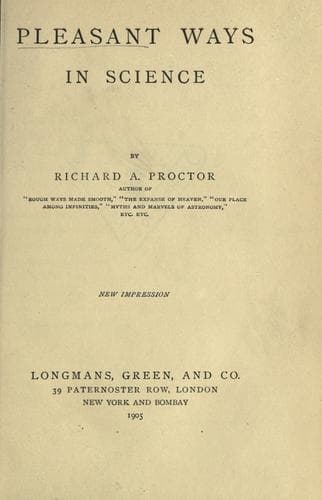
Pleasant Ways in ScienceProctor, Richard A. (Richard Anthony)
Science
Pleasant Ways in Science
Proctor, Richard A. (Richard Anthony)
Science
It is strange that the problem of determining the sun’s distance, which
for many ages was regarded as altogether insoluble, and which even
during later years had seemed fairly solvable in but one or two ways,
should be found, on closer investigation, to admit of many methods
of solution. If astronomers should only be as fortunate hereafter in
dealing with the problem of determining the distances of the stars,
as they have been with the question of the sun’s distance, we may
hope for knowledge respecting the structure of the universe such as
even the Herschels despaired of our ever gaining. Yet this problem of
determining star-distances does not seem more intractable, now, than
the problem of measuring the sun’s distance appeared only two centuries
ago. If we rightly view the many methods devised for dealing with the
easier task, we must admit that the more difficult—which, by the way,
is in reality infinitely the more interesting—cannot be regarded
as so utterly hopeless as, with our present methods and appliances,
it appears to be. True, we know only the distances of two or three
stars, approximately, and have means of forming a vague opinion
about the distances of only a dozen others, or thereabouts, while at
distances now immeasurable lie six thousand stars visible to the eye,
and twenty millions within range of the telescope. Yet, in Galileo’s
time, men might have argued similarly against all hope of measuring
the proportions of the solar system. “We know only,” they might have
urged, “the distance of the moon, our immediate neighbour,—beyond
her, at distances so great that hers, so far as we can judge, is by
comparison almost as nothing, lie the Sun and Mercury, Venus and Mars;
further away yet lie Jupiter and Saturn, and possibly other planets,
not visible to the naked eye, but within range of that wonderful
instrument, the telescope, which our Galileo and others are using so
successfully. What hope can there be, when the exact measurement of the
moon’s distance has so fully taxed our powers of celestial measurement,
that we can ever obtain exact information respecting the distances of
the sun and planets? By what method is a problem so stupendous to be
attacked?” Yet, within a few years of that time, Kepler had formed
already a rough estimate of the distance of the sun; in 1639, young
Horrocks pointed to a method which has since been successfully applied.
Before the end of the seventeenth century Cassini and Flamsteed had
approached the solution of the problem more nearly, while Hailey had
definitely formulated the method which bears his name. Long before the
end of the eighteenth century it was certainly known that the sun’s
distance lies between 85 millions of miles and 98 millions (Kepler,
Cassini, and Flamsteed had been unable to indicate any superior limit).
And lastly, in our own time, half a score of methods, each subdivisible
into several forms, have been applied to the solution of this
Public-domain text, read in full here on John Shaqi.
Reviews
Reviews
No reviews yet
Be the first to share your thoughts on this work.
Join the Discussion
Join the discussion
Sign in to leave a comment or review.
Sign InorCreate an account