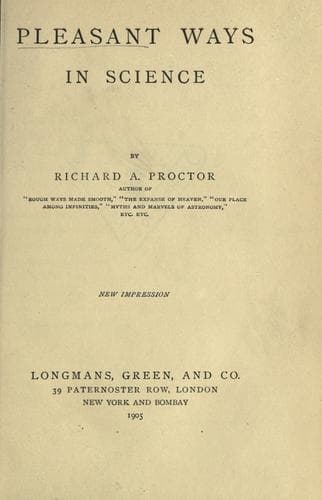
Pleasant Ways in ScienceProctor, Richard A. (Richard Anthony)
Science
Pleasant Ways in Science
Proctor, Richard A. (Richard Anthony)
Science
fundamental problem of observational astronomy.
I propose now to sketch some new and very promising methods, which have
been applied already with a degree of success arguing well for the
prospects of future applications of the methods under more favourable
conditions.
In the first place, let us very briefly consider the methods which had
been before employed, in order that the proper position of the new
methods may be more clearly recognized.
The plan obviously suggested at the outset for the solution of the
problem was simply to deal with it as a problem of surveying. It was
in such a manner that the moon’s distance had been found, and the
only difficulty in applying the method to the sun or to any planet
consisted in the delicacy of the observations required. The earth being
the only surveying-ground available to astronomers in dealing with
this problem (in dealing with the problem of the stars’ distances they
have a very much wider field of operations), it was necessary that
a base-line should be measured on this globe of ours,—large enough
compared with our small selves, but utterly insignificant compared
with the dimensions of the solar system. The diameter of the earth
being less than 8000 miles, the longest line which the observers could
take for base scarcely exceeded 6000 miles; since observations of the
same celestial object at opposite ends of a diameter necessarily imply
that the object is in the horizon of _both_ the observing stations
(for precisely the same reason that two cords stretched from the ends
of any diameter of a ball to a distant point touch the ball at those
ends). But the sun’s distance being some 92 millions of miles, a base
of 6000 miles amounts to less than the 15,000th part of the distance
to be measured. Conceive a surveyor endeavouring to determine the
distance of a steeple or rock 15,000 feet, or nearly three miles, from
him, with a base-line _one foot_ in length, and you can conceive the
task of astronomers who should attempt to apply the direct surveying
method to determine the sun’s distance,—at least, you have one of
their difficulties strikingly illustrated, though a number of others
remain which the illustration does not indicate. For, after all, a
base one foot in length, though far too short, is a convenient one in
many respects: the observer can pass from one end to the other without
trouble—he looks at the distant object under almost exactly the same
conditions from each end, and so forth. A base 6000 miles long for
determining the sun’s distance is too short in precisely the same
degree, but it is assuredly not so convenient a base for the observer.
A giant 36,000 miles high would find it as convenient as a surveyor
six feet high would find a one foot base-line; but astronomers, as
a rule, are less than 36,000 miles in height. Accordingly the same
observer cannot work at both ends of the base-line, and they have to
send out expeditions to occupy each station. All the circumstances
Public-domain text, read in full here on John Shaqi.
Reviews
Reviews
No reviews yet
Be the first to share your thoughts on this work.
Join the Discussion
Join the discussion
Sign in to leave a comment or review.
Sign InorCreate an account