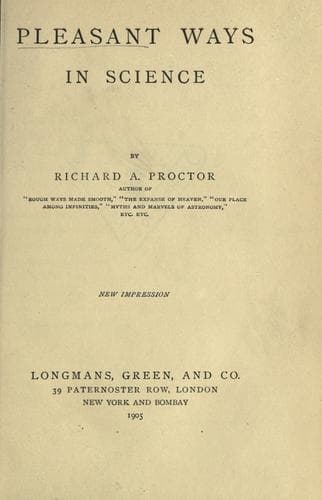
Pleasant Ways in ScienceProctor, Richard A. (Richard Anthony)
Science
Pleasant Ways in Science
Proctor, Richard A. (Richard Anthony)
Science
The earth travels along in her orbit at the rate of about 18⅓ miles
in every second of time. Not to enter into niceties which could only
properly be dealt with mathematically, it may be said that with this
full velocity she is at times approaching the remoter planets of the
system, and at times receding from them; so that here at once is a
range of difference amounting to about 37 miles per second, and fairly
within the power of the new method of observation. For it matters
nothing, so far as the new method is concerned, whether the earth is
approaching another orb by her motion, or that orb approaching by its
own motion. Again, the plant Venus travels at the rate of about 21½
miles per second, but as the earth travels only 3 miles a second less
swiftly, and the same way round, only a small portion of Venus’s motion
ever appears as a motion of approach towards or recession from the
earth. Still, Venus is sometimes approaching and sometimes receding
from the earth, at a rate of more than 8 miles per second. Her light
is much brighter than that of Jupiter or Saturn, and accordingly this
smaller rate of motion would be probably more easily recognized than
the greater rate at which the giant planets are sometimes approaching
and at other times receding from the earth. At least, the Greenwich
observers seem to have confined their attention to Venus, so far as
motions of planets in the line of sight are concerned. The moon, as
a body which keeps always at nearly the same distance from us, would
of course be the last in the world to be selected to give positive
evidence in favour of the new method; but she serves to afford a useful
test of the qualities of the instruments employed. If when these were
applied to her they gave evidence of motions of recession or approach
at the rate of several miles per second, when we know as a matter of
fact that the moon’s distance never[14] varies by more than 30,000
miles during the lunar month, her rate of approach or recession thus
averaging about one-fiftieth part of a mile per second, discredit
would be thrown on the new method—not, indeed, as regards its
principle, which no competent reasoner can for a moment question, but
as regards the possibility of practically applying it with our present
instrumental means.
Public-domain text, read in full here on John Shaqi.
Reviews
Reviews
No reviews yet
Be the first to share your thoughts on this work.
Elsewhere in the archive
Join the Discussion
Join the discussion
Sign in to leave a comment or review.
Sign InorCreate an account