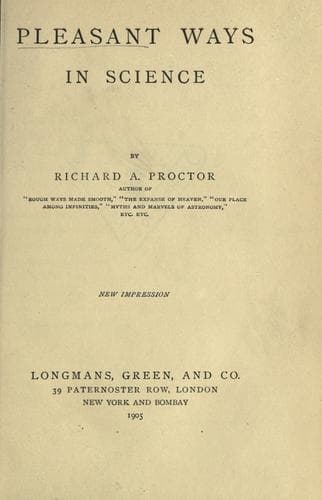
Pleasant Ways in ScienceProctor, Richard A. (Richard Anthony)
Science
Pleasant Ways in Science
Proctor, Richard A. (Richard Anthony)
Science
Observations have been made at Greenwich, both on Venus and on the
moon, by the new method, with results entirely satisfactory. The method
shows that Venus is receding when she is known to be receding, and
that she is approaching when she is known to be approaching. Again,
the method shows no signs of approach or recession in the moon’s case.
It is thus in satisfactory agreement with the known facts. Of course
these results are open to the objection that the observers have known
beforehand what to expect, and that expectation often deceives the
mind, especially in cases where the thing to be observed is not at all
easy to recognize. It will presently be seen that the new method has
been more satisfactorily tested, in this respect, in other ways. It may
be partly due to the effect of expectation that in the case of Venus
the motions of approach and recession, tested by the new method, have
always been somewhat too great. A part of the excess may be due to the
use of the measure of the sun’s distance, and therefore the measures
of the dimensions of the solar system, in vogue before the recent
transit. These measures fall short to some degree of those which result
from the observations made in December, 1874, on Venus in transit, the
sun’s distance being estimated at about 91,400,000 miles instead of
92,000,000 miles, which would seem to be nearer the real distance. Of
course all the motions within the solar system would be correspondingly
under-estimated. On the other hand, the new method would give all
velocities with absolute correctness if instrumental difficulties
could be overcome. The difference between the real velocities of Venus
approaching and receding, and those calculated according to the present
inexact estimate of the sun’s distance, is however much less than
the observed discrepancy, doubtless due to the difficulties involved
in the application of this most difficult method. I note the point,
chiefly for the sake of mentioning the circumstance that theoretically
the method affords a new means of measuring the dimensions of the
solar system. Whensoever the practical application of the method has
been so far improved that the rate of approach or recession of Venus,
or Mercury, or Jupiter, or Saturn (any one of these planets), can be
determined on any occasion, with great nicety, we can at once infer
the sun’s distance with corresponding exactness. Considering that
the method has only been invented ten years (setting aside Doppler’s
first vague ideas respecting it), and that spectroscopic analysis as a
method of exact observation is as yet little more than a quarter of
a century old, we may fairly hope that in the years to come the new
method, already successfully applied to measure motions of recession
and approach at the rate of 20 or 30 miles per second, will be employed
successfully in measuring much smaller velocities. Then will it give
us a new method of measuring the great base-line of astronomical
Public-domain text, read in full here on John Shaqi.
Reviews
Reviews
No reviews yet
Be the first to share your thoughts on this work.
Elsewhere in the archive
Join the Discussion
Join the discussion
Sign in to leave a comment or review.
Sign InorCreate an account