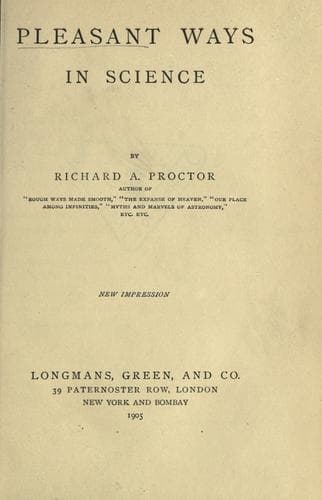
Pleasant Ways in ScienceProctor, Richard A. (Richard Anthony)
Science
Pleasant Ways in Science
Proctor, Richard A. (Richard Anthony)
Science
surveying—the distance of our world from the centre of the solar
system.
That this will one day happen is rendered highly probable, in my
opinion, by the successes next to be related.
Besides the motions of the planets around the sun, there are their
motions of rotation, and the rotation of the sun himself upon his
axis. Some among these turning motions are sufficiently rapid to be
dealt with by the new method. The most rapid rotational motion with
which we are acquainted from actual observation is that of the planet
Jupiter. The circuit of his equator amounts to about 267,000 miles,
and he turns once on his axis in a few minutes less than ten hours, so
that his equatorial surface travels at the rate of about 26,700 miles
an hour, or nearly 7½ miles per second. Thus between the advancing and
retreating sides of the equator there is a difference of motion in
the line of sight amounting to nearly 15 miles. But this is not all.
Jupiter shines by reflecting sunlight. Now it is easily seen that where
his turning equator _meets_ the waves of light from the sun, these are
shortened, in the same sense that waves are shortened for a swimmer
travelling to meet them, while these waves, already shortened in this
way, are further shortened when starting from the same advancing
surface of Jupiter, on their journey to us after reflection. In this
way the shortening of the waves is doubled, at least when the earth is
so placed that Jupiter lies in the same direction from us as from the
sun, the very time, in fact, when Jupiter is most favourably placed
for ordinary observation, or is at his highest due south, when the sun
is at his lowest below the northern horizon—that is, at midnight.
The lengthening of the waves is similarly doubled at this most
favourable time for observation; and the actual difference between the
motion of the two sides of Jupiter’s equator being nearly 15 miles
per second, the effect on the light-waves is equivalent to that due
to a difference of nearly 30 miles per second. Thus the new method
may fairly be expected to indicate Jupiter’s motion of rotation. The
Greenwich observers have succeeded in applying it, though Jupiter has
not been favourably situated for observation. Only on one occasion,
says Sir G. Airy, was the spectrum of Jupiter “seen fairly well,”
and on that occasion “measures were obtained which gave a result in
remarkable agreement with the calculated value.” It may well be hoped
that when in the course of a few years Jupiter returns to that part of
his course where he rises high above the horizon, shining more brightly
and through a less perturbed air, the new method will be still more
successfully applied. We may even hope to see it extended to Saturn,
not merely to confirm the measures already made of Saturn’s rotation,
but to resolve the doubts which exist as to the rotation of Saturn’s
ring-system.
Public-domain text, read in full here on John Shaqi.
Reviews
Reviews
No reviews yet
Be the first to share your thoughts on this work.
Elsewhere in the archive
Join the Discussion
Join the discussion
Sign in to leave a comment or review.
Sign InorCreate an account