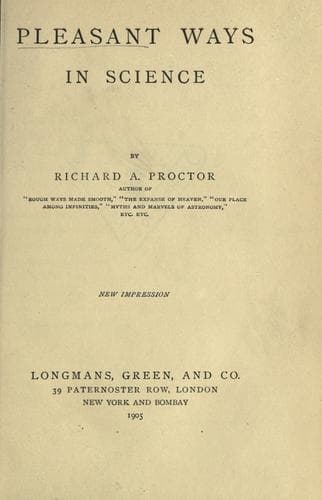
Pleasant Ways in ScienceProctor, Richard A. (Richard Anthony)
Science
Pleasant Ways in Science
Proctor, Richard A. (Richard Anthony)
Science
I dwell here on the question of quantity, which is sometimes overlooked
in considering the spectroscopic evidence of the sun’s condition, but
is in reality a very important factor in determining the nature of the
evidence relating to each element in the solar mass. In some cases,
the quantity of a material necessary to give unmistakable spectroscopic
evidence is singularly small; insomuch that new elements, as thallium,
cæsium, rubidium, and gallium, have been actually first recognized
by their spectral lines when existing in such minute quantities in
the substances examined as to give no other trace whatever of their
existence. But it would be altogether a mistake to suppose that some
element existing in exceedingly small quantities, or, more correctly,
existing in the form of an exceedingly rare vapour in the sun’s
atmosphere, would be detected by means of its dark lines, or _by any
other method depending on the study of the solar spectrum_. When we
place a small portion of some substance in the space between the carbon
points of an electric lamp, and volatilize that substance in the
voltaic arc, we obtain a spectrum including all the bright lines of the
various elements contained in the substance; and if some element is
contained in it in exceedingly small quantity, we may yet perceive its
distinctive bright lines among the others (many of them far brighter)
belonging to the elements present in greater quantities. But if we have
(for example) a great mass of molten iron, the rainbow-tinted spectrum
of whose light we examine from a great distance, and if a small
quantity of sodium, or other substance which vaporizes at moderate
temperatures, be cast into the molten iron so that the vapour of the
added element presently rises above the glowing surface of the iron,
no trace of the presence of this vapour would be shown in the spectrum
observed from a distance. The part of the spectrum where the dark lines
of sodium usually appear would, undoubtedly, be less brilliant than
before, in the same sense that the sun may be said to be less brilliant
when the air is in the least degree moist than when it is perfectly
dry; but the loss of brilliancy is as utterly imperceptible in the one
case as it is in the other. In like manner, a vapour might exist in
the atmosphere of the sun (above the photosphere, that is), of whose
presence not a trace would be afforded in the spectroscope, for the
simple reason that the absorptive action of the vapour, though exerted
to reduce the brightness of particular solar rays or tints, would not
affect those rays sufficiently for the spectroscopist to recognize any
diminution of their lustre.
Public-domain text, read in full here on John Shaqi.
Reviews
Reviews
No reviews yet
Be the first to share your thoughts on this work.
Join the Discussion
Join the discussion
Sign in to leave a comment or review.
Sign InorCreate an account