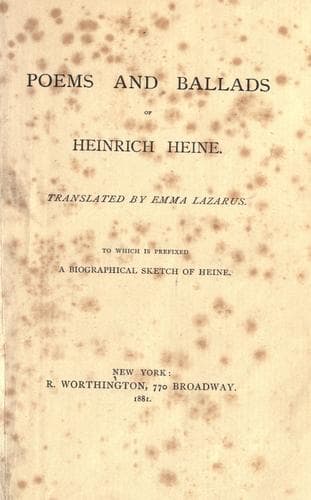
Poems and Ballads of Heinrich HeineHeine, Heinrich
General
Poems and Ballads of Heinrich Heine
Heine, Heinrich
German poetry -- Translations into English
Thus side by side flowed on the continuous streams of that wit and
pathos which he poured forth inexhaustibly to the very end. No word of
complaint or impatience ever passed his lips; on the contrary, with
his old, irresistible humor, his fancy played about his own privations
and sufferings, and tried to alleviate for his devoted wife and
friends the pain of the heart-rending spectacle. His delicate
consideration prompted him to spare his venerable mother all knowledge
of his illness. He wrote to her every month in his customary cheerful
way; and, in sending her the latest volumes of his poetry, he caused a
separate copy always to be printed, from which all allusions to his
malady were expunged. "For that matter," he said, "that any son could
be as wretched and miserable as I, no mother would believe."
Alas! if he had known how much more eloquent and noble a refutation
his life would afford than his mistaken passionate response to the
imputations of his enemies! Is this patient martyr the man of whom
Boerne wrote: "with his sybarite nature, the fall of a rose-leaf can
disturb Heine's slumber. He whom all asperities fatigue, whom all
discords trouble, let such a one neither move nor think--let him go to
bed and shut his eyes."
Only in his last poems, which were not to be published till after his
death, has Heine given free vent to the bitterness of his anguish.
During the long sleepless night when he lay writhing with pain or
exhausted by previous paroxysms, his mind, preternaturally clear and
vigorous, conceived the glowing fantasies of the _Romancero_, or the
Job-like lamentations of the _Lazarus_ poems. This mental exercise was
his protection against insanity: and the thought of his cherished
wife, he affirmed, was his only safeguard against the delirious desire
to seize the morphine bottle by his side, and with one draught put an
end to his agony. On the night of the 16th of February, 1856, came the
long-craved release--and on the 20th of February without mass or
"Kaddish," according to his express wish, he was buried in the
cemetery of Montmartre.
EARLY POEMS.
SONNETS TO MY MOTHER, B. HEINE, _nee_ VON GELDERN.
I.
I have been wont to bear my forehead high--
My stubborn temper yields with no good grace.
The king himself might look me in the face,
And yet I would not downward cast mine eye.
But I confess, dear mother, openly,
However proud my haughty spirit swell,
When I within thy blessed presence dwell,
Oft am I smit with shy humility.
Is it thy soul, with secret influence,
Thy lofty soul piercing all shows of sense,
Which soareth, heaven-born, to heaven again?
Or springs it from sad memories that tell
How many a time I caused thy dear heart pain,
Thy gentle heart, that loveth me so well!
II.
Public-domain text, read in full here on John Shaqi.
Reviews
Reviews
No reviews yet
Be the first to share your thoughts on this work.
Join the Discussion
Join the discussion
Sign in to leave a comment or review.
Sign InorCreate an account