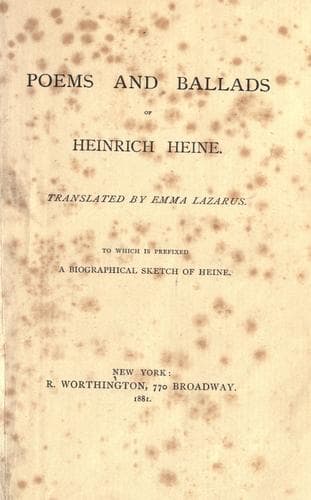
Poems and Ballads of Heinrich HeineHeine, Heinrich
General
Poems and Ballads of Heinrich Heine
Heine, Heinrich
German poetry -- Translations into English
add any words of justification; it can only excite our sympathy for
the haughty poet doomed to drain so bitter a cup. He was pressed to
take the oath of naturalization, but he had too painful experience of
the renunciation of his birthright ever to consent to a repetition of
his error. He would not forfeit the right to have inscribed upon his
tomb-stone: "Here lies a German poet."
In 1844 his uncle Solomon died; and, as there was no stipulation in
the banker's will that the yearly allowance hitherto granted to
Heinrich should continue, the oldest heir Karl announced that this
would altogether cease. This very cousin Karl had been nursed by Heine
at the risk of his own life during the cholera-plague of 1832 in
Paris. The grief and excitement caused by his kinsman's ingratitude
fearfully accelerated the progress of the malady which had long been
gaining upon the poet, and which proved to be a softening of the
spinal cord. One eye was paralyzed, he lost the sense of taste, and
complained that everything he ate was like clay. His physicians
agreed that he had few weeks to live, and he felt that he was dying,
little divining that the agony was to be prolonged for ten horrible
years. It is unnecessary to dwell upon these years of darkness, in
which Heine, shriveled to the proportions of a child, languished upon
his "mattress-grave" in Paris. His patient resignation, his
indomitable will, his sweetness and gayety of temper, and his
unimpaired vigor and fertility of intellect, are too fresh in the
memory of many living witnesses, and have been too frequently and
recently described to make it needful here to enlarge upon them. In
the crucial hour he proved no recreant to the convictions for which he
had battled and bled during a lifetime. Of the report that his illness
had materially modified his religious opinions, he has left a complete
and emphatic denial. "I must expressly contradict the rumor that I
have retreated to the threshold of any sort of church, or that I have
reposed upon its bosom. No! My religious views and convictions have
remained free from all churchdom; no belfry chime has allured me, no
altar taper has dazzled me. I have trifled with no symbol, and have
not utterly renounced my reason. I have forsworn nothing--not even my
old pagan-gods, from whom it is true I have parted, but parted in love
and friendship."
"I am no longer a divine biped," he wrote. "I am no longer the freest
German after Goethe, as Ruge named me in healthier days. I am no
longer the great hero No. 2, who was compared with the grape-crowned
Dionysius, whilst my colleague No. 1 enjoyed the title of a Grand
Ducal Wlimarian Jupiter. I am no longer a joyous, somewhat corpulent
Hellenist, laughing cheerfully down upon the melancholy Nazarenes. I
am now a poor fatally-ill Jew, an emaciated picture of woe, an unhappy
man."
Public-domain text, read in full here on John Shaqi.
Reviews
Reviews
No reviews yet
Be the first to share your thoughts on this work.
Join the Discussion
Join the discussion
Sign in to leave a comment or review.
Sign InorCreate an account