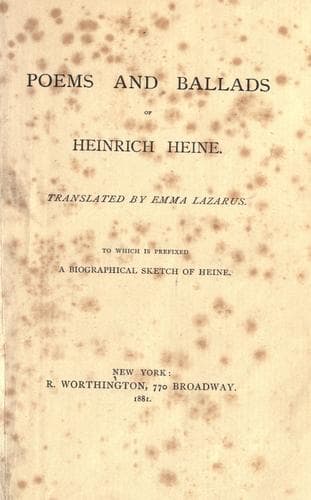
Poems and Ballads of Heinrich HeineHeine, Heinrich
General
Poems and Ballads of Heinrich Heine
Heine, Heinrich
German poetry -- Translations into English
During the summer of 1830, while he was loitering at Helgoland, he was
roused to feverish excitement by the news of the July Revolution. He
inveighed against the nobility in a preface to a pamphlet, called
_Kahldorf on the Nobility_, which largely increased the number of his
powerful enemies. The literary censorship had long mutilated his prose
writings, besides materially diminishing his legitimate income by
prohibiting the sale of many of his works. He now began to fear that
his personal liberty would be restricted as summarily as his literary
activity; and in May, 1831, he took up his residence in Paris. He
perfected himself in the French language, and by his brilliant essays
on French art, German philosophy, and the Romantic School, soon
acquired the reputation of one of the best prose writers of France,
and the "wittiest Frenchman since Voltaire." He became deeply
interested in the doctrine of St. Simonism, then at its culminating
point in Paris. Its central idea of the rehabilitation of the flesh,
and the sacredness of labor, found an enthusiastic champion in him who
had so long denounced the impracticable spiritualism of Christianity.
He, the logical clear-headed sceptic in all matters pertaining to
existing systems and creeds, seems possessed with the credulity of a
child in regard to every scheme of human regeneration, or shall we
call it the exaltation of the Jew, for whom the Messiah has not yet
arrived, but is none the less confidently and hourly expected?
Embittered by repeated disappointments, by his enforced exile, by a
nervous disease which had afflicted him from his youth, and was now
fast gaining upon him, and by the impending shadow of actual want,
Heine's tone now assumes a concentrated acridity, and his poetry
acquires a reckless audacity of theme and treatment. His _Neue
Lieder_, addressed to notorious Parisian women, were regarded as an
insult to decency. In literary merit many of them vie with the best of
his earlier songs; but the daring defiance of public opinion displayed
in the choice of subject excluded all other criticism than that of
indignation and rebuke. There is but a single ray to lighten the
gathering gloom of Heine's life at this period. In a letter dated,
April 11th, 1835, occurs his first mention of his _liaison_ with the
grisette Mathilde Crescence Mirat, who afterwards became his wife.
This uneducated, simple-hearted, affectionate child-wife inspired in
the poet, weary of intellectual strife, a love as tender and constant
as it had been sudden and passionate. A variety of circumstances
having combined to reduce Heine to extreme want, he had recourse to a
step which has been very severely censured. He applied for and
received from the French government a pension from the fund set aside
for "all those who by their zeal for the cause of the Revolution had
more or less compromised themselves at home or abroad." Now that the
particulars of the case are so well known, it would be superfluous to
Public-domain text, read in full here on John Shaqi.
Reviews
Reviews
No reviews yet
Be the first to share your thoughts on this work.
Join the Discussion
Join the discussion
Sign in to leave a comment or review.
Sign InorCreate an account