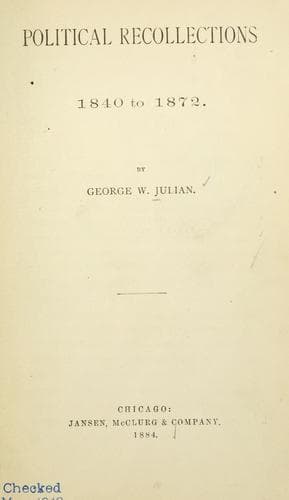
Political Recollections: 1840 to 1872Julian, George Washington
History
Political Recollections: 1840 to 1872
Julian, George Washington
Republican Party (U.S. : 1854- ) -- History; United States -- Politics and government
The nomination was a perfect surprise to the country, because Mr.
Polk was wholly unknown to the people as a statesman. Like Governor
Hayes, when nominated in 1876, he belonged to the "illustrious
obscure." The astonished native who, on hearing the news, suddenly
inquired of a bystander, "Who the devil is Polk?" simply echoed
the common feeling, while his question provoked the general laughter
of the Whigs. For a time the nomination was somewhat disappointing
to the Democrats themselves; but they soon rallied, and finally
went into the canvass very earnestly, and with a united front.
The Whigs began the campaign in high hopes and in fact with unbounded
confidence in their success. Their great captain was in command,
and they took comfort in his favorite utterance that "truth is
omnipotent, and public justice certain." To pit him against such
a pigmy as Polk seemed to them a miserable burlesque, and they
counted their triumph as already perfectly assured. They claimed
the advantage on the question of annexation, and still more as to
the tariff, since the act of 1842 was popular, and Polk was known
to be a free-trader of the Calhoun school. As the canvass proceeded,
however, it became evident that the fight was to be fierce and
bitter to the last degree, and that the issue, after all, was not
so certain. Mr. Polk, notwithstanding his obscurity, was able to
rouse the enthusiasm of his party, North and South, to a very
remarkable degree. The annexation pill was swallowed by many
Democrats whose support of him had been deemed morally impossible.
In New York, where the opposition was strongest, leading Democrats,
with William Cullen Bryant as their head, denounced the annexation
scheme and repudiated the paragraph of the National platform which
favored it, and yet voted for Polk, who owed his nomination solely
to the fact that he had committed himself to the policy of immediate
and unconditional annexation, thus anticipating the sickly political
morality of 1852, when so many men of repute tried in vain to save
both their consciences and their party orthodoxy by "spitting upon
the platform and swallowing the candidate who stood upon it."
History will have to record that the action of these New York
Democrats saved the ticket in that State, and justly attaches to
them the responsibility for the very evils to the country against
which they so eloquently warned their brethren. The power of the
spoils came in as a tremendous make-weight, while the party lash
was vigorously flourished, and the "independent voter" was as
hateful to the party managers on both sides as we find him to-day.
Those who refused to wear the party collar were branded by the
"organs" as a "pestiferous and demoralizing brood," who deserved
"extermination." Discipline was rigorously enforced, and made to
take the place of argument. As regards the tariff question, Mr.
Polk's letter to Judge Kane, of Philadelphia, of the 19th of June,
Public-domain text, read in full here on John Shaqi.
Reviews
Reviews
No reviews yet
Be the first to share your thoughts on this work.
Join the Discussion
Join the discussion
Sign in to leave a comment or review.
Sign InorCreate an account