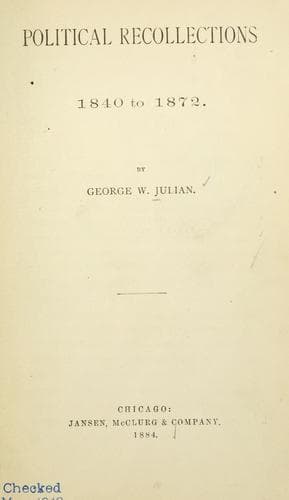
Political Recollections: 1840 to 1872 — John Shaqi
Political Recollections: 1840 to 1872Julian, George Washington
History
Political Recollections: 1840 to 1872
Julian, George Washington
Republican Party (U.S. : 1854- ) -- History; United States -- Politics and government
enabled his friends completely to turn the tables on the Whigs of
Pennsylvania, where "Polk, Dallas, and the tariff of 1842," was
blazoned on the Democratic banners, and thousands of Democrats were
actually made to believe that Polk was even a better tariff man
than Clay. This letter, committing its free-trade author to the
principle of a revenue tariff, with "reasonable incidental protection
to our home industries," was translated into German and printed in
all the party papers; and as a triumphant effort to make the people
believe a lie, and a masterpiece of political duplicity employed
by the great party as a means of success, it had no precedent in
American politics. In later times, however, it has been completely
eclipsed by the scheme of "tissue ballots," and other wholesale
methods of balking the popular will in the South, by the successful
effort to cheat the nation out of the right to choose its Chief
Magistrate in 1876, and by the startling bribery of a great
commonwealth four years later, now unblushingly confessed by the
party leaders who accomplished it.
In the meantime the spirit of discontent began to manifest itself
among the Whigs of the South respecting Mr. Clay's attitude on the
question of annexation, and in a moment of weakness he wrote his
unfortunate "Alabama letter," of the 27th of July. In that letter
he said: "I do not think the subject of slavery ought to affect
the question one way or the other. Whether Texas be independent
or incorporated into the United States, I do not believe it will
prolong or shorten the duration of that institution." He also
declared that he would be "glad to see it, without dishonor, without
war, with the common consent of the Union, and upon just and fair
terms." These words were perfectly chilling to his anti-slavery
supporters, who were utterly opposed to annexation on _any_ terms,
because the power of slavery would thus inevitably be extended and
strengthened in the United States. The letter was an irreparable
mistake. It was a fresh example of his besetting tendency to
mediate between opposing policies, and undoubtedly drove from his
support many who would otherwise have followed the Whig banner to
the end.
Public-domain text, read in full here on John Shaqi.
Reviews
Reviews
No reviews yet
Be the first to share your thoughts on this work.
Join the Discussion
Join the discussion
Sign in to leave a comment or review.
Sign InorCreate an account