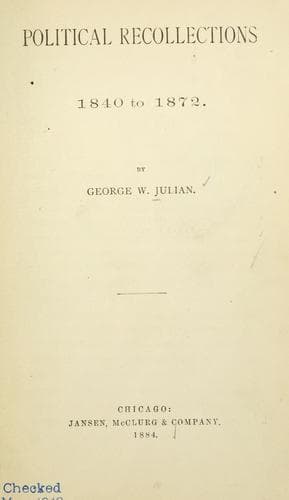
Political Recollections: 1840 to 1872 — John Shaqi
Political Recollections: 1840 to 1872Julian, George Washington
History
Political Recollections: 1840 to 1872
Julian, George Washington
Republican Party (U.S. : 1854- ) -- History; United States -- Politics and government
But the cause of Mr. Clay's defeat which was dwelt upon with most
emphasis and feeling was the action of the Liberty party. Birney,
its candidate for President, received 66,304 votes, and these, it
was alleged, came chiefly from the Whig party. The vote of these
men in New York and Michigan was greater than the Democratic
majority, so that if they had united with the Whigs, Clay would
have been elected in spite of all other opposition. Mr. Polk's
plurality over Clay in New York was only 5,106, while Birney received
in that State 15,812; and Horace Greeley insisted that if only one
third of this vote had been cast for Mr. Clay, he would have been
President. The feeling of the Whigs against these anti-slavery
men was bitter and damnatory to the last degree. The Plaquemine
frauds, the Kane letter, and everything else, were forgotten in
the general and abounding wrath against these "fanatics," who were
denounced as the betrayers of their country and of the cause which
a very great and critical opportunity had placed it in their power
to save. "The Abolitionists deserve to be damned, and they will
be," said a zealous Whig to an anti-slavery Quaker; and this was
simply the expression of the prevailing feeling at this time, at
least in the West.
But this treatment of the Abolitionists was manifestly unjust.
Their organization four years before was neither untimely nor
unnecessary, but belonged to the inevitable logic of a great and
dominating idea. A party was absolutely necessary which should
make this idea paramount, and utterly refuse to be drawn away from
it by any party divisions upon subsidiary questions. It should be
remembered, too, that the Liberty party was made up of Democratic
as well as Whig deserters, and that if it had disbanded, or had
not been formed, the result of this election would have been the
same. The statement of Mr. Greeley, that one third of Birney's
vote in New York would have elected Clay, was unwarranted, unless
he was able to show what would have been the action of the other
two thirds. In justice to these Abolitionists it should also be
remembered and recorded, to say the very least, that Mr. Clay
himself divided with them the responsibility of his defeat by his
Alabama letter, and that now, in the clear perspective of history,
they stand vindicated against their Whig assailants, whose fevered
brains and party intolerance blinded their eyes to the truth.
Doubtless there were honest differences of opinion as to the best
method of serving the anti-slavery cause in this exasperating
campaign, and these differences may still survive as an inheritance;
but abolitionism, as a working force in our politics, had to have
a beginning, and no man who cherishes the memory of the old Free
Soil party, and of the larger one to which it gave birth, will
withhold the meed of his praise from the heroic little band of
sappers and miners who blazed the way for the armies which were to
Public-domain text, read in full here on John Shaqi.
Reviews
Reviews
No reviews yet
Be the first to share your thoughts on this work.
Join the Discussion
Join the discussion
Sign in to leave a comment or review.
Sign InorCreate an account