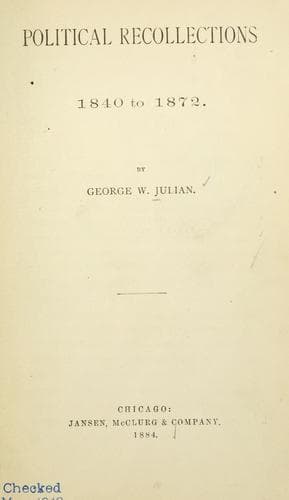
Political Recollections: 1840 to 1872Julian, George Washington
History
Political Recollections: 1840 to 1872
Julian, George Washington
Republican Party (U.S. : 1854- ) -- History; United States -- Politics and government
follow, and whose voices, though but faintly heard in the whirlwind
of 1840, were made significantly audible in 1844. Although they
were everywhere totally misunderstood and grossly misrepresented,
they clearly comprehended their work and courageously entered upon
its performance. Their political creed was substantially identical
with that of the Free Soilers of 1848 and the Republicans of 1856
and 1860. They were anything but political fanatics, and history
will record that their sole offense was the espousal of the truth
in advance of the multitude, which slowly and finally followed in
their footsteps.
But the war against slavery was not at all intermitted by the
victory of the Democrats. Events are schoolmasters, and this
triumph only quickened their march toward the final catastrophe.
Cassius M. Clay, who had espoused the Whig cause in this canvass
with great vigor and zeal, and on anti-slavery grounds, re-enlisted
in the battle against slavery, and resolved to prosecute it by new
methods. He had been sorely tried by Mr. Clay's Alabama letter
and the Whig defeat, but he was now armed with fresh courage, and
resolved to "carry the war into Africa" by the establishment of
his newspaper, the "True American," in Lexington, in his own State.
His arraignment of slavery was so eloquent and masterly that a
large meeting of slave-holders appointed a committee to wait on
him, and request the discontinuance of his paper. His reply was:
"Go, tell your secret conclave of cowardly assassins that Cassius
M. Clay knows his rights, and how to defend them." These words
thrilled all lovers of liberty, and sounded to them like a trumpet
call to battle. Another fruitful event was the effort of Massachusetts,
in the fall of this year, to protect her colored seamen in the
ports of Charleston and New Orleans, where they were seized on
merchant ships and sold into slavery under local police regulations.
When Mr. Hoar visited Charleston as the accredited agent of his
State for the purpose of taking measures to test the constitutionality
of these regulations, the Legislature of South Carolina, by a vote
of one hundred and nineteen against one, passed a series of outrageous
resolutions culminating in a request to the Governor to expel him
from the State as a confessed disturber of the peace. He was
obliged summarily to depart, as the only means of escaping the
vengeance of the mob. This open and insolent defiance of the
national authority could not fail to strengthen anti-slavery opinion
in the Northern States. The same end was served by an unexpected
movement in New Hampshire. This State, like Massachusetts and
Vermont, had taken ground against annexation, but it wheeled into
line after Polk was nominated. John P. Hale, however, then a
Democratic member of Congress from that State, refused to follow
his party, and for this reason, after he had been formally declared
its choice for re-election, he was thrown overboard, and another
candidate nominated.
Public-domain text, read in full here on John Shaqi.
Reviews
Reviews
No reviews yet
Be the first to share your thoughts on this work.
Join the Discussion
Join the discussion
Sign in to leave a comment or review.
Sign InorCreate an account