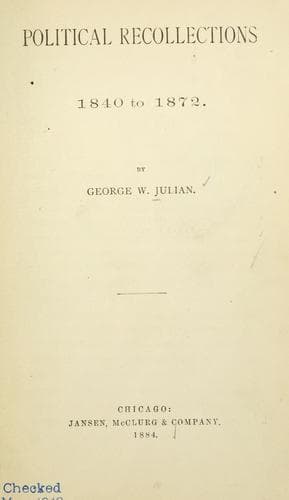
Political Recollections: 1840 to 1872Julian, George Washington
History
Political Recollections: 1840 to 1872
Julian, George Washington
Republican Party (U.S. : 1854- ) -- History; United States -- Politics and government
No election, however, was effected, and his
seat remained vacant during the 29th Congress, but he obtained a
seat in the Legislature in 1846, and the following year was chosen
United States Senator, while Amos Tuck, afterward a prominent Free
Soiler, was elected to the Lower House of Congress. These were
pregnant events, and especially the triumph of Hale, who became a
very formidable champion of freedom, and a thorn in the side of
slavery till it perished.
In the meantime the hunger for immediate annexation had been whetted
by the election of Mr. Polk, and its champions hurried up their
work, and pushed it by methods in open disregard of the Constitution
and of our treaty obligations with Mexico. In the last hours of
the administration of John Tyler the atrocious plot received its
finishing touch and the Executive approval, and, in the apt words
of the ablest and fairest historian of the transaction, "the bridal
dress in which Calhoun had led the beloved of the slaveocracy to
the Union was the torn and tattered Constitution of the United
States." War with Mexico, as prophesied by the Whigs, speedily
followed. As early as August, 1845, General Taylor was ordered by
President Polk to advance to a position on the Nueces. In March
of the following year, in pursuance of further orders, his army
again advanced, taking its position on the east bank of the Rio
Grande, and, of course, on the soil of Mexico. Hostilities naturally
followed, and after two battles the President, in his message to
Congress, declared that "American blood has been shed on American
soil." This robust Executive falsehood, with which the slave power
compelled him to face the civilized world, must always hold a very
high rank in the annals of public audacity and crime. It is what
Thomas Carlyle might have styled "the second power of a lie," and
is only rivaled by the parallel falsehood of Congress in declaring
that "by the act of the Republic of Mexico a state of war exists
between that Government and the United States." In the message of
the President referred to, he recommended that a considerable sum
of money be placed at his disposal for the purpose of negotiating
a peace, and it was on the consideration of this message that David
Wilmot fortunately obtained the floor, and moved his memorable
proviso for the interdiction of slavery in any territory which
might be wrested from Mexico by our arms. This was the session of
Congress for 1846-47, and the proposition passed the House with
great unanimity as to the Northern members. At the following
session of Congress, on the 28th of February, 1848, the proviso
again came before the House, and the motion to lay it on the table
failed, all the Whigs and a large majority of the Democrats from
the free States voting in the negative. It passed the House on
the 13th of December following, on a similar division of parties
and sections, but the Senate refused to concur, and the Thirtieth
Public-domain text, read in full here on John Shaqi.
Reviews
Reviews
No reviews yet
Be the first to share your thoughts on this work.
Join the Discussion
Join the discussion
Sign in to leave a comment or review.
Sign InorCreate an account