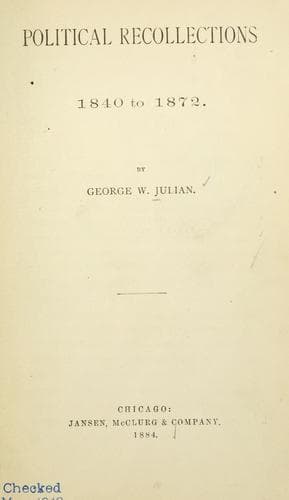
Political Recollections: 1840 to 1872Julian, George Washington
History
Political Recollections: 1840 to 1872
Julian, George Washington
Republican Party (U.S. : 1854- ) -- History; United States -- Politics and government
believe his dying words in July, "I have tried to do my duty," were
the key-note of his life, and that in the Presidential campaign of
1848, I did him much, though unintentional, injustice.
It was about the same time that I called with other Western members
to see Mr. Clay, at the National Hotel. He received us with the
most gracious cordiality, and perfectly captivated us all by the
peculiar and proverbial charm of his manners and conversation. I
remember nothing like it in the social intercourse of my life.
One of our party was Hon. L. D. Campbell, then a prominent Whig
politician of Ohio, and an old friend of Mr. Clay, who seemed
anxious to explain his action in supporting Gen. Scott in the
National Convention of 1848. He failed to satisfy Mr. Clay, whose
eye kindled during the conversation, and who had desired and counted
on the nomination himself. Mr. Clay, addressing him, but turning
to me, said: "I can readily understand the position of our friend
from Indiana, whose strong opinions on the slavery question governed
his action; but your position was different, and, besides, General
Scott had no chance for the nomination, and you were under no
obligation to support him." He spoke in kindly terms of the Free
Soil men; said they acted consistently in supporting Van Buren in
preference to Taylor, and that the election of the latter would
prove the ruin of the Whigs. I heard Mr. Clay's great speech in
the Senate on the Compromise Measures, and although I believed him
to be radically wrong, I felt myself at times drawn toward him by
that peculiar spell which years before had bound me to him as my
idolized political leader. I witnessed his principal encounters
with Col. Benton during this session, in which I thought the latter
had the better of the argument; but his reply to Mr. Barnwell, of
South Carolina, on July 22d, in which he said: "I owe a paramount
allegiance to the whole Union, a subordinate one to my State," and
denounced the treasonable utterances of Mr. Rhett, was altogether
inimitable and unsurpassed. In the same speech he showed as little
quarter to the Abolitionists. Turning to Mr. Hale, he said, "They
live by agitation. It is their meat, their bread, the air which
they breathe; and if they saw in its incipient state, a measure
giving them more of that food, and meat, and bread, and air, do
you believe they would oppose themselves to its adoption? Do you
not believe that they would _hail_ [Hale] it as a blessing? * * *
They see their doom as certain as there is a God in heaven, who
sends his providential dispensations to calm the threatening storm,
and to tranquilize agitated men. As certain as God exists in
heaven, your business, your vocation, is gone." His devotion to
the Union was his ruling passion, and in one of his numerous speeches
during this session he held up a fragment of Washington's coffin,
and with much dramatic effect pleaded for reconciliation and peace
between the warring sections.
Public-domain text, read in full here on John Shaqi.
Reviews
Reviews
No reviews yet
Be the first to share your thoughts on this work.
Join the Discussion
Join the discussion
Sign in to leave a comment or review.
Sign InorCreate an account