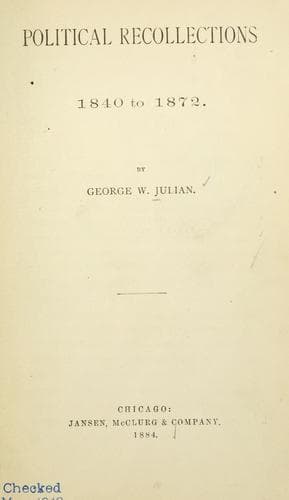
Political Recollections: 1840 to 1872Julian, George Washington
History
Political Recollections: 1840 to 1872
Julian, George Washington
Republican Party (U.S. : 1854- ) -- History; United States -- Politics and government
His scheme of compromise, or "omnibus bill," was the darling child
of his political ambition and old age; and when, after lovingly
nursing it and gallantly fighting for it through seven or eight
weary months, he saw it cruelly dismembered on July 31st, and his
sovereign remedy for our national troubles insulted by the separate
passage of the bill providing a Territorial Government for Utah,
I could not help feeling a profound personal sympathy with him.
Beaten at last on every point, deserted by some senators in whom
he had trusted implicitly, crushed and exhausted by labors which
few young and vigorous men could have endured, he bowed to the
inevitable, and retired from the Senate Chamber. But in the next
morning, prior to his departure for the sea-shore, he was in his
seat; and with lightning in his eye, and figure erect as ever, he
paid his respects to the men whose work of political havoc he
deplored. His impassioned arraignment of the disunionists was
loudly applauded by the galleries, and clearly indicated the part
he would have played in the late Rebellion had his life been spared
to witness that direful event. "So long," said he, "as it pleases
God to give me a voice to express my sentiments, or an arm, weak
and enfeebled as it may be by age, that voice and that arm will be
on the side of my country, for the support of the general authority,
and for the maintenance of the powers of this Union."
I heard the famous "Seventh of March Speech" of Mr. Webster. To
me his oratory was a perfect surprise and curiosity. He not only
spoke with very unusual deliberation, but with pauses having no
relation whatever to the sense. His sentences were broken into
the oddest fragments, and the hearer was perplexed in the endeavor
to gather his meaning. In declaring, for example, that he "would
put in no Wilmot proviso for the purpose of a taunt," etc., he made
a long pause at "Wilmot," perhaps half a minute, and finally, having
apparently recovered his breath, added the word "proviso"; and
then, after another considerable pause, went on with his sentence.
His speaking seemed painfully laborious. Great drops of perspiration
stood upon his forehead and face, notwithstanding the slowness of
his utterance, suggesting, as a possible explanation, a very recent
and heavy dinner, or a greatly troubled conscience over his final
act of apostasy from his early New England faith. The latter was
probably the truth, since he is known to have long and seriously
pondered the question of his ultimate decision; and with his
naturally great and noble traits of character he could not have
announced it without manifest tokens of uneasiness. I was greatly
interested in the brief dialogue between him and Mr. Calhoun, which
followed this speech. Reference was made to their famous passage-
at-arms twenty years before; and Mr. Calhoun, while taking exception
to some of Mr. Webster's positions, congratulated him on his strong
deliverance in the interest of slavery.
Public-domain text, read in full here on John Shaqi.
Reviews
Reviews
No reviews yet
Be the first to share your thoughts on this work.
Join the Discussion
Join the discussion
Sign in to leave a comment or review.
Sign InorCreate an account