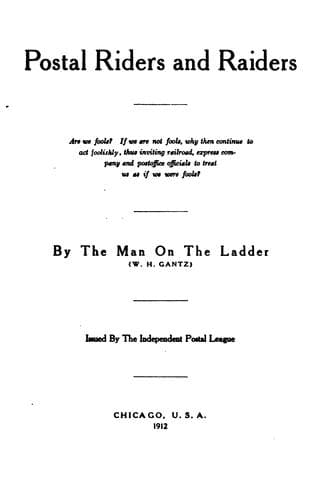
Postal service -- United States -- Second-class matter
Nor is that all. My boss’ grocer got three letters from that cracker
baker and a visit from a salesman of a local jobber before he “stocked.”
If the grocers named by the other six ladies were similarly honored then
the builder of those biscuits must have written the seven grocers whom
the tea party ladies had named fourteen letters in addition to the first
one.
That contributed 28 cents more in postage stamps for cancellation.
Now let us figure up--or down--how one tea party of seven (I was the
working or “worked” member, so am not to be counted in), and a one page
“ad” stands in account with the postal revenues.
The magazine carrying the cracker “ad” weighs about a pound. The single
“ad” page cannot possibly weigh more than _three-fiftieths of one ounce_.
To carry and deliver that one “ad” page the cost to the government, then,
even at Mr. Hitchcock’s extension-ladder rate of 9 cents a pound, would
be about _one-thirtieth of one cent_.
But as we did in the case of the school advertisements previously
mentioned, let’s give our Postmaster General the whole “hullin’ uv
beans.” Let us credit the government with Mr. Hitchcock’s alleged cost of
carrying that magazine to that tea party--nine cents.
Per contra, the government must give that “ad” page credit for producing
stamp cancellations to the amount of $2.30.
Figure it out yourself and see if that is not the _actual_ showing of the
ledger on this account of the Postoffice Department with that one “ad”
page and those seven tea party women.
That, I believe, is fair and sufficient evidence from the outside--from
the field--in support of the facts which the publishers present in their
“Exhibit F,” and which I shall here reprint:
The astonishing record contained in (Exhibit E), of the
absolutely unvarying coincidence of decreases in postoffice
deficits with increases in second-class mail is square up against
the Postmaster General’s statements that the department loses
8.23 cents on every pound of second-class mail and loses over
$60,000,000 a year as a whole, on second-class mail.
What is the explanation? How can the phenomenon of constantly
decreasing deficits, coincident with increasing second-class
mail, be reconciled? To be sure, the Postmaster General has been
trying for two years to make out a case against the magazines,
and nothing is better understood than that, _under orders_, he is
using all the figures and the infinite opportunities of such a
complex mass of figures as those of the postoffice, to make the
case for the magazines as bad as possible. Of course, it does not
cost the department 9.23 cents a pound for second-class matter;
but also, of course, in all probability, the cost must be more
than one-ninth Postmaster General Hitchcock’s figures. Then why
is it that _the more second-class matter there is mailed the more
money the Postoffice Department has_?
Public-domain text, read in full here on John Shaqi.
Reviews
Reviews
No reviews yet
Be the first to share your thoughts on this work.
Elsewhere in the archive
Join the Discussion
Join the discussion
Sign in to leave a comment or review.
Sign InorCreate an account