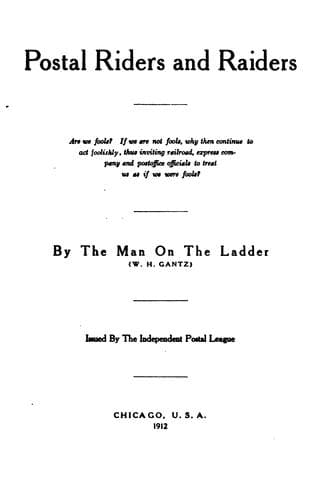
Postal service -- United States -- Second-class matter
If the Adams Express Company and its Southern associate were the
only ones to shower their members with unheard-of profits we
might be inclined to think they had been visited with peculiar
and exceptional good fortune. Such is far from being the case.
Let us proceed alphabetically and see how the members of the
American Express Company have fared.
The Adams and American are easily the two most important of the
express companies, and control, or have controlled at various
times, all the other important companies with the exception of
the Pacific. Since 1868 the capital of the American has stood
at $18,000,000, this stock having been issued in exchange for
the shares of the original American Express Company and the
Merchants’ Union Express Company, under articles of merger and
association dated November 25, 1868. The company’s books show
that $5,300,000 _was the value_ of the assets taken over at that
time. There was $183,819 in cash; $1,261,023 in securities;
$2,200,300 in real estate, less a mortgage of $505,143; and
$1,260,000 in equipment; making a total of $4,400,000. New stock
was sold which realized $900,000 in cash, making a total of
$5,300,000 in assets for the $18,000,000 of stock. _No new stock
has been issued since 1868 and no further cash has been paid into
the treasury except from earnings._
From its own balance sheet we find the company now has less than
$10,000,000 in _real property and equipment_, all of which does
not represent property employed in the service, _because the
item “real property” includes real estate investments_.
With an original investment in cash and property of but one-third
the par value of its capital stock, the American Express Company
now pays dividends on this stock of 12% a year and for many years
paid 6, 8 and 10%. Moreover, it has accumulated from its earnings
a fund of _more than $20,000,000_ which is invested in readily
negotiable stocks and bonds, the yearly income on which amounted
to $1,178,000 in 1909. Among these securities are such high-grade
railroad stocks as Chicago and Northwestern, Northern Pacific,
New Haven, New York Central and Union Pacific.
Public-domain text, read in full here on John Shaqi.
Reviews
Reviews
No reviews yet
Be the first to share your thoughts on this work.
Elsewhere in the archive
Join the Discussion
Join the discussion
Sign in to leave a comment or review.
Sign InorCreate an account