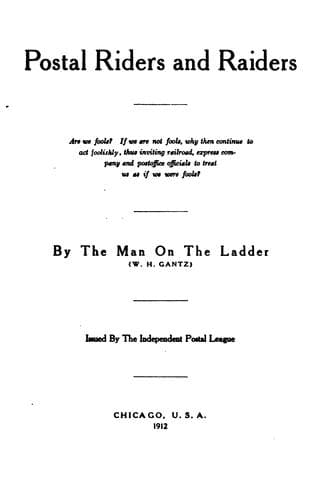
Postal service -- United States -- Second-class matter
I had intended to omit that “In Memoriam.” Then I carefully read it over.
The appalling slaughter of the “innocents” which it exposes was so new to
me, news of such a tragic nature in the domain of periodical publishing,
that I then and there changed my mind. I am of the opinion that the news
conveyed in its five brief paragraphs will be as new and as surprising
to most of my readers as it was to me. Think of 42,623 publications put
out of business in _ten years_? Of 4,229 sent to the commercial--in most
instances, probably, to the _financial_--junk pile in one year--last
year? Then think of the causes this conscientious writer holds chargeable
for a large share of the slaughter!
ATTEMPT TO BREACH THE CONSTITUTION.
We will now revert to the bold attempt made in presenting that rider
amendment to the postoffice appropriation bill to breach the federal
constitution, following which we will take up some of Mr. Hitchcock’s
efforts to show how much or how little he knows about the business of
publishing and distributing magazines and other periodical literature.
First let us inquire if Mr. Hitchcock and the coterie backing that
Senate “rider” _knew_ that, under the Constitution, all measures for
raising federal revenue must originate in the Lower House of Congress?
One scarcely dares conclude they were so densely ignorant as that. Then,
was theirs a deliberate, calculated attempt to breach the constitutional
prerogatives and rights of the Lower House? Did they figure upon putting
through that vicious rider in the congested closing hours of Congress?
I call them the _crooked_ hours of Congress. Did those backers of that
rider _hope_ that Senators and Congressmen would overlook or fail to read
that rider, hope that so many would be so fully occupied by the swan-song
chorus being sung during those closing hours that they would not notice
that “rider” jumping the constitutional hurdles?
Now, if either one of the last assigned reasons is valid, a word stronger
than “ignorance” should apply to such tricky, treacherous action, whether
it is practiced by Senators, Congressmen, cabinet chiefs or chiefs higher
up. One greatly dislikes to apply a fitting term to such ulterior motives
as lead high and respected public officials to breach the constitution by
trickery about on a level with that of the sneak thief or with that of
a “con” man who thinks he has done his full duty by the people when he
has sold Reuben the painted brick. But how could Mr. Hitchcock and those
Senators co-operating with him be ignorant of the plain letter of the law
and supported by a long line of precedents in both the Senate and the
House?
Public-domain text, read in full here on John Shaqi.
Reviews
Reviews
No reviews yet
Be the first to share your thoughts on this work.
Join the Discussion
Join the discussion
Sign in to leave a comment or review.
Sign InorCreate an account