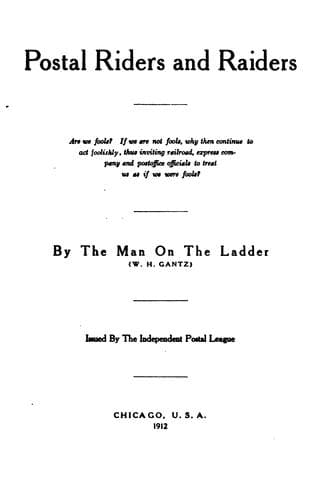
Postal service -- United States -- Second-class matter
As to the Senate precedents for the House’s right to originate all
measures for the raising of revenues, Mr. Henry H. Gilfry, Chief Clerk
of the Senate, compiled in 1871 a work entitled “Decisions on Points of
Order with Phraseology in the United States Senate.” Mr. Gilfry cites the
attempt of the Senate to repeal the income tax. The House returned the
bill to the Senate with a reminder that the Constitution “vests in the
House of Representatives the sole power to originate such measures.” Mr.
Gilfry cites many other precedents.
In 1905 the Senate tried to originate revenues by amendment to the
postoffice appropriation bill. That amendment was very similar to the
“rider” of Mr. Hitchcock. I will here reprint it:
“That hereafter the rate of postage on packages of books or merchandise
mailed at the distributing postoffice of any rural free delivery to a
patron on said route shall be three cents for each pound or any fraction
thereof. This rate shall apply only to packages deposited at the local
postoffice for delivery to patrons on routes emanating from that office,
or collected by rural carriers for delivery to the office from which the
route emanates, and not to mail transmitted from one office to another,
and shall not apply to packages exceeding 5 pounds in weight.”
The House brought that measure to conference and flatly _refused to
recognize the power of the Senate in the premises_. The Senate receded
and the amendment was killed.
“Hinds’ Precedents of the House of Representatives” is a recognized
authority. In Chapter XLII, Vol. 2, under the caption, “Prerogatives of
the House as to Revenue Legislation,” Mr. Hinds cites many instances in
which the House had invariably insisted upon the _exclusive exercise of
its rights as defined in Section 7, Article 1, of the Constitution_.
Mr. Hinds cites in all one hundred and twenty-five precedents, each
of which raises the same point of order as was raised in debating Mr.
Hitchcock’s late “rider” and on each of which the House _maintained its
right to originate all bills for raising revenues_.
In view of the fact that some of Mr. Hitchcock’s supporters were men
of experience, skilled parliamentarians, in view of the fact that
some of them were trained lawyers, and in view of the further fact
that the works both of Mr. Hinds and of Mr. Gilfry are on file in the
reference libraries of the Senate and House and probably in most of the
departments, how, I ask, in view of the above facts, can either Mr.
Hitchcock or any of his supporters enter a valid plea of _ignorance_ of
the fact that their attempt to put over that rider was contravening the
constitutional rights and prerogatives of the House?
Public-domain text, read in full here on John Shaqi.
Reviews
Reviews
No reviews yet
Be the first to share your thoughts on this work.
Join the Discussion
Join the discussion
Sign in to leave a comment or review.
Sign InorCreate an account