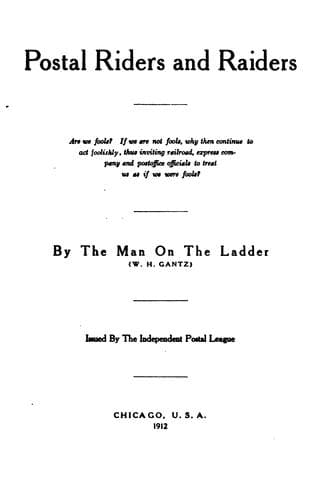
Postal service -- United States -- Second-class matter
No, they were not ignorant. In my judgment, as based upon the reports
which have reached me, that “rider” was a deliberate frame-up and its
architects were a few conspirators who sought by means of that rider
either to put certain periodicals out of business or _force them to print
what they were told to publish_.
Possibly I may be in error as to this, but the careful observation of
the best informed and most experienced correspondents on the Washington
assignment, as well as a number of Senators and Congressmen, have, in
reports made, supplied ample evidence to warrant my statement to the
effect that there was a collusive understanding among a few people to
present that “rider” in the closing hours of the session with the hope
that in the rush of affairs it might escape notice and go through. And
that hope was born of an ulterior purpose to get even with some monthly
and weekly publications--publications of _independent_ thought and
voice and which have for several years been _telling the truth_ about
certain Senators and Congressmen. These independent periodicals have
also been telling a rapidly growing multitude of eager readers the cold,
unvarnished facts about some corporations and corporate interests which,
it is generally believed and openly charged, are represented in federal
legislation and in cabinet and other official circles in Washington _by
several of the very men who were so actively supporting Mr. Hitchcock in
pushing his “rider” over the legislative course_.
A brief summary of the history of that rider may be presented at
this point. The Penrose-Overstreet bill was before the House in the
early part of 1910. It carried no recommendation of an increased rate
on second-class matter. This Penrose-Overstreet bill was, however,
reintroduced in the House by Congressman Weeks, of Massachusetts,
Chairman of the House Postoffice Committee, and by Senator Carter in
the Senate. The House refused either to approve or take action on Mr.
Hitchcock’s recommendation. After consideration, the Senate approved
the House bill. That bill carried no recommendation for an increase in
second-class postage rates. Not a single member of the Senate during the
debate suggested nor introduced any bill or amendment recommending such
increase.
In his message of December, 1910, President Taft recommended an increase
in the second-class mail rates. His recommendation was couched in
language very similar to that used in his message of December, 1909.
Mr. Samuel Blythe, from whom I have previously quoted extendedly, says
some pertinent things in commenting on the situation at this point in our
brief outline of how this “rider” got mounted for a lap or two and then
was blanketed in the home-stretch:
Public-domain text, read in full here on John Shaqi.
Reviews
Reviews
No reviews yet
Be the first to share your thoughts on this work.
Join the Discussion
Join the discussion
Sign in to leave a comment or review.
Sign InorCreate an account