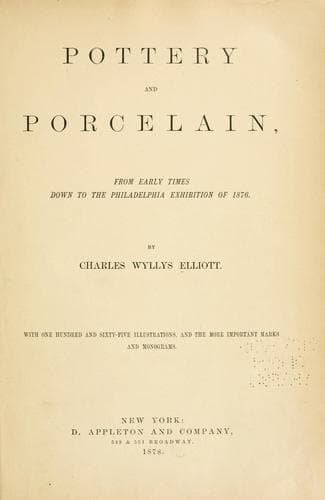
Pottery and Porcelain, from early times down to the Philadelphia exhibition of 1876Elliott, Charles Wyllys
History
Pottery and Porcelain, from early times down to the Philadelphia exhibition of 1876
Elliott, Charles Wyllys
Pottery -- History; Pottery -- Marks
[Illustration: _The double triangle, with numerals and letters._]
Besides these more important manufactories of porcelain were a number of
less note, which sprang up during this period of active interest; such
as those of _Ludwigsburg_, or _Kronenburg_, _Fulda_, _Hesse-Cassel_,
etc.
In THURINGIA, also, were a number of small establishments, many of which
produced fine work.
Marks of Ludwigsburg, or Kronenburg:
[Illustration: _From 1758._]
[Illustration: _Sometimes without the crown._]
Mark of Fulda, in Hesse (1763 to 1780):
[Illustration: _Signifying the Prince of Fulda._]
Marks of Limbach, in Saxe-Meiningen (about 1760):
[Illustration: _Sometimes this was a script L._]
[Illustration: _Another mark._]
In SWITZERLAND, at Nyon and at Zurich, small factories went to work,
whose productions are sought for by collectors; but they do not reach
the importance of the leading German establishments. The manufactory at
Nyon (1712) had sometimes a fish, and sometimes a painter's name in
script-letters, as _Guide_, or _G_.
[Illustration: _Nyon-mark._]
[Illustration: _The mark of Zurich_ (1755).]
CHAPTER XIII.
THE PORCELAIN OF FRANCE--ST.-CLOUD, CHANTILLY, SÈVRES, ETC.
Hard and Soft Porcelain.--Discovery of Kaolin.--St.-Cloud.--_Pâte
Tendre._--Marks.--Rouen.--Small Manufactories.--Marks of
same.--Chantilly.--Sceaux-Penthièvre.--Niderviller.--Marks.
--Limoges.--Sèvres.--Flower-Work.--Hard Porcelain, _Pâte Dure_.
--The Grand Monarque.--Florid Taste.--Boucher.--Vieux
Sèvres.--Three Vases.--Greek Vases.--Prices at Bernal
Sale.--Chemists.--Colors used.--Collections.--Art Museums.
--Alexandre Brongniart.--Marks and Dates.
The porcelain of Sèvres is probably better known than any other by name,
if not by sight. The production has been steadily under the protection
of the state since 1760, when the crown became sole owner of the works.
Time, thought, skill, talent, ingenuity, and money, have been spent upon
this work unceasingly for more than a century; and some of the most
elaborate, most finished, and most costly pieces of porcelain which the
world has anywhere seen, have come out of the small town of Sèvres.
Kings, nobles, poets, painters, have recognized the beauty and value of
this work, and have given of their strength to help it onward toward
perfection.
The history of the manufactory at Sèvres might fill a book: here we are
limited to a brief space, which may suffice for most readers.
Some experts hold that _true_ porcelain is only what is known as hard
porcelain, called _pâte dure_ by the French. Such is always the
porcelain of China and Japan; such is that of Dresden and the centre of
Europe.
This hard porcelain has always the two qualities of hardness and
translucency. We have elsewhere explained to what these qualities are
due, and how and when they were brought to perfection in Europe, first
at Dresden or Meissen (see Dresden porcelain).
Public-domain text, read in full here on John Shaqi.
Reviews
Reviews
No reviews yet
Be the first to share your thoughts on this work.
Elsewhere in the archive
Join the Discussion
Join the discussion
Sign in to leave a comment or review.
Sign InorCreate an account