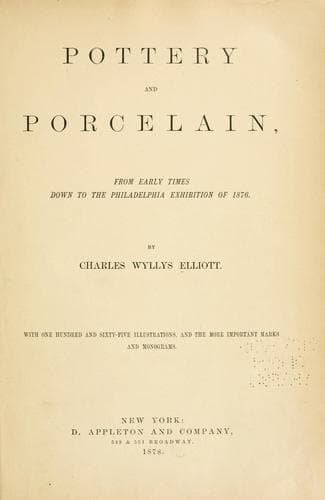
Pottery and Porcelain, from early times down to the Philadelphia exhibition of 1876Elliott, Charles Wyllys
History
Pottery and Porcelain, from early times down to the Philadelphia exhibition of 1876
Elliott, Charles Wyllys
Pottery -- History; Pottery -- Marks
France lacked the peculiar clay necessary for making hard porcelain till
the year 1765, when chance discovered the magic earth at St.-Yrieix;
after which time its manufacture was brought to a high pitch of
excellence at Sèvres.
The soft porcelain, or _pâte tendre_, can be made without the admixture
of the clay called by the Chinese _kaolin_. It has the quality of
translucency, but lacks hardness and strength. It melts at a lower heat,
and, while very delicate and beautiful, it is not so enduring as the
_pâte dure_. Experts can distinguish the two at sight; but there are
some signs which will help the uninitiated. The soft porcelain is likely
to be more creamy, and softer to the eye and touch, than the hard; the
painting blends more into the glaze; the bottoms of the pieces or the
rims are covered with the glaze; while, in the hard porcelain, these
rims, from standing on the sanded floor of the furnaces, show no glaze.
The painting on the hard porcelain is likely to be sharper, and more on
the surface, than that on the soft, into which it seems to melt.
ST.-CLOUD.--Before the discovery of kaolin in Europe, as early as 1695,
soft porcelain, or _pâte tendre_, was made at St.-Cloud in great variety
and of considerable excellence; and the story of French porcelain, begun
there, may be divided into two parts: 1. Soft porcelain, begun at
St.-Cloud in 1695, continued there, and afterward at Chantilly; then at
Vincennes, in 1745; still later at Sèvres, in 1756. The production of
soft porcelain, or _pâte tendre_, continued at Sèvres, in company with
that of the _pâte dure_, until 1804. 2. The hard porcelain, or _pâte
dure_ of the French; which was made after the discovery of the kaolin of
St.-Yrieix, at Sèvres.
Marks used at St.-Cloud:
[Illustration: _The mark of the Sun._]
[Illustration: _Another one._]
[Illustration: _The fleur-de-lis, sometimes impressed._]
[Illustration: _This mark indicated the factory and the name of the
director (Trou) from_ 1730 to 1762.]
The early porcelain made at St.-Cloud is said to have been quite coarse
and unsatisfactory. Examples of it are very scarce. That made later was
better, but a long way behind what was made afterward at Sèvres.
At ROUEN, in France, porcelain appears to have been made, but it never
proceeded so far as to be a business.
At MENECY-VILLEROY, about 1735, soft paste was made; and later there
were various limited efforts at Brancas-Lauraguais, at Arras, at
Vincennes, at Boulogne, at Étoilles, at Bourg-la-Reine, at Clignancourt,
at Orleans, at Luneville, at Bordeaux, at Valenciennes, at Limoges, at
Sarreguemines, at Strasbourg; at Paris, a great number, some of the
products of which are still in existence.
We give the marks of some of the most important.
Marks of Clignancourt:
[Illustration: _A windmill in blue._]
[Illustration: _Another form._]
[Illustration: _This varies a good deal_ (1775).]
[Illustration: _Monograms of Louis Stanislas Xavier, Count de
Provence._]
Public-domain text, read in full here on John Shaqi.
Reviews
Reviews
No reviews yet
Be the first to share your thoughts on this work.
Elsewhere in the archive
Join the Discussion
Join the discussion
Sign in to leave a comment or review.
Sign InorCreate an account