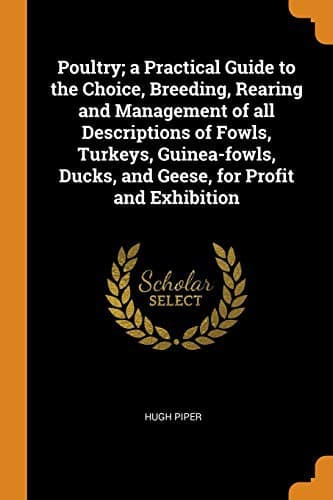
Poultry: A Practical Guide to the Choice, Breeding, Rearing, and Management of all Descriptions of Fowls, Turkeys, Guinea-fowls, Ducks, and Geese, for Profit and Exhibition.Piper, Hugh
Science
Poultry: A Practical Guide to the Choice, Breeding, Rearing, and Management of all Descriptions of Fowls, Turkeys, Guinea-fowls, Ducks, and Geese, for Profit and Exhibition.
Piper, Hugh
Poultry -- Breeding
The openness of the feathers of fowls which do not throw off the water
well, like those of most birds, enables them to cleanse themselves
easier from insects and dirt, by dusting their feathers, and then
shaking off the dirt and these minute pests with the dust. For this
purpose one or more ample heaps of sifted ashes, or very dry sand or
earth, for them to roll in, must be placed in the sun, and, if possible,
under shelter, so as to be warm and perfectly dry. Wood ashes are the
best. This dust-heap is as necessary to fowls as water for washing is to
human beings. It cleanses their feathers and skin from vermin and
impurities, promotes the cuticular or skin excretion, and is materially
instrumental in preserving their health. If they should be much troubled
with insects, mix in the heap plenty of wood ashes and a little flour of
sulphur.
A good supply of old mortar-rubbish, or similar substance, must be kept
under the shed, or in a dry place, to provide material for the
eggshells, or the hens will be liable to lay soft-shelled eggs. Burnt
oyster-shells are an excellent substitute for common lime, and should be
prepared for use by being heated red-hot, and when cold broken into
small pieces with the fingers, but not powdered. Some give chopped or
ground bones, or a lump of chalky marl. Eggshells roughly crushed are
also good, and are greedily devoured by the hens.
A good supply of gravel is also essential, the small stones which the
fowls swallow being necessary to enable them to digest their hard food.
Fowls swallow all grain whole, their bills not being adapted for
crushing it like the teeth of the rabbit or the horse, and it is
prepared for digestion by the action of a strong and muscular gizzard,
lined with a tough leathery membrane, which forms a remarkable
peculiarity in the internal structure of fowls and turkeys. "By the
action," says Mr. W. H. L. Martin, "of the two thick muscular sides of
this gizzard on each other, the seeds and grains swallowed (and
previously macerated in the crop, and there softened by a peculiar
secretion oozing from glandular pores) are ground up, or triturated in
order that their due digestion may take place. It is a remarkable fact
that these birds are in the habit of swallowing small pebbles, bits of
gravel, and similar substances, which it would seem are essential to
their health. The definite use of these substances, which are certainly
ground down by the mill-like action of the gizzard, has been a matter
of difference among various physiologists, and many experiments, with a
view to elucidate the subject, have been undertaken. It was sufficiently
proved by Spallanzani that the digestive fluid was incapable of
dissolving grains of barley, &c., in their unbruised state; and this he
ascertained by filling small hollow and perforated balls and tubes of
metal or glass with grain, and causing them to be swallowed by turkeys
and other fowls; when examined, after twenty-four and forty-eight hours,
Public-domain text, read in full here on John Shaqi.
Reviews
Reviews
No reviews yet
Be the first to share your thoughts on this work.
Join the Discussion
Join the discussion
Sign in to leave a comment or review.
Sign InorCreate an account