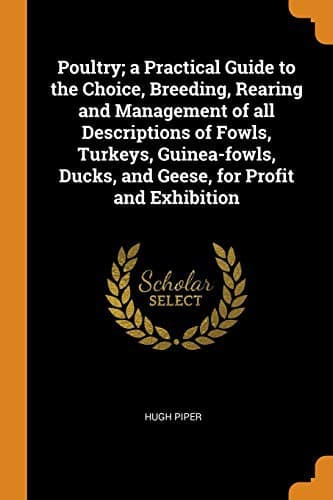
Poultry: A Practical Guide to the Choice, Breeding, Rearing, and Management of all Descriptions of Fowls, Turkeys, Guinea-fowls, Ducks, and Geese, for Profit and Exhibition. — John Shaqi
Poultry: A Practical Guide to the Choice, Breeding, Rearing, and Management of all Descriptions of Fowls, Turkeys, Guinea-fowls, Ducks, and Geese, for Profit and Exhibition.Piper, Hugh
Science
Poultry: A Practical Guide to the Choice, Breeding, Rearing, and Management of all Descriptions of Fowls, Turkeys, Guinea-fowls, Ducks, and Geese, for Profit and Exhibition.
Piper, Hugh
Poultry -- Breeding
the grains were found to be unaffected by the gastric fluid; but when he
filled similar balls and tubes with bruised grains, and caused them to
be swallowed, he found, after a lapse of the same number of hours, that
they were more or less dissolved by the action of the gastric juice. In
other experiments, he found that metallic tubes introduced into the
gizzard of common fowls and turkeys, were bruised, crushed, and
distorted, and even that sharp-cutting instruments were broken up into
blunt fragments without having produced the slightest injury to the
gizzard. But these experiments go rather to prove the extraordinary
force and grinding powers of the gizzard, than to throw light upon the
positive use of the pebbles swallowed; which, after all, Spallanzani
thought were swallowed without any definite object, but from mere
stupidity. Blumenbach and Dr. Bostock aver that fowls, however well
supplied with food, grow lean without them, and to this we can bear our
own testimony. Yet the question, what is their precise effect? remains
to be answered. Boerhave thought it probable that they might act as
absorbents to superabundant acid; others have regarded them as irritants
or stimulants to digestion; and Borelli supposed that they might really
contribute some degree of nutriment."
Sir Everard Home, in his "Comparative Anatomy," says: "When the external
form of this organ is first attentively examined, viewing that side
which is anterior in the living bird, and on which the two bellies of
the muscle and middle are more distinct, there being no other part to
obstruct the view, the belly of the muscle on the left side is seen to
be larger than on the right. This appears, on reflection, to be of great
advantage in producing the necessary motion; for if the two muscles were
of equal strength, they must keep a greater degree of exertion than is
necessary; while, in the present case, the principal effect is produced
by that of the left side, and a smaller force is used by that on the
right to bring the parts back again. The two bellies of the muscle, by
their alternate action, produce two effects--the one a constant friction
on the contents of the cavity; the other, a pressure on them. This last
arises from a swelling of the muscle inwards, which readily explains all
the instances which have been given by Spallanzani and others, of the
force of the gizzard upon substances introduced into it--a force which
is found by their experiments always to act in an oblique direction. The
internal cavity, when opened in this distended state, is found to be of
an oval form, the long diameter being in the line of the body; its
capacity nearly equal to the size of a pullet's egg; and on the sides
there are ridges in their horny coat (lining membrane) in the long
direction of the oval. When the horny coat is examined in its internal
structure, the fibres of which it is formed are not found in a direction
perpendicular to the ligamentous substance behind it; but in the upper
Public-domain text, read in full here on John Shaqi.
Reviews
Reviews
No reviews yet
Be the first to share your thoughts on this work.
Join the Discussion
Join the discussion
Sign in to leave a comment or review.
Sign InorCreate an account