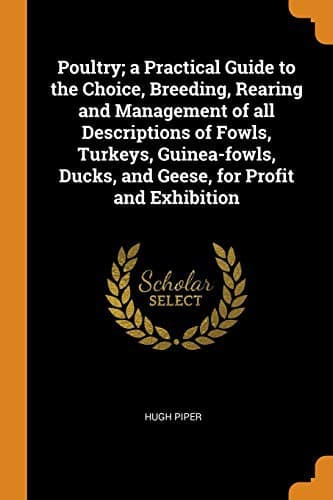
Poultry: A Practical Guide to the Choice, Breeding, Rearing, and Management of all Descriptions of Fowls, Turkeys, Guinea-fowls, Ducks, and Geese, for Profit and Exhibition. — John Shaqi
Poultry: A Practical Guide to the Choice, Breeding, Rearing, and Management of all Descriptions of Fowls, Turkeys, Guinea-fowls, Ducks, and Geese, for Profit and Exhibition.Piper, Hugh
Science
Poultry: A Practical Guide to the Choice, Breeding, Rearing, and Management of all Descriptions of Fowls, Turkeys, Guinea-fowls, Ducks, and Geese, for Profit and Exhibition.
Piper, Hugh
Poultry -- Breeding
Some poultry-keepers recommend that the grain should be boiled, which
makes it swell greatly, and consequently fills the fowl's crop with a
smaller quantity, and the bird is satisfied with less than if dry grain
be given; but others say that the fowls derive more nutriment from the
same quantity of grain unboiled. Indeed, it seems evident that a portion
of the nutriment must pass into the water, and also evaporate in steam.
The fowl's gizzard being a powerful grinding mill, evidently designed by
Providence for the purpose of crushing the grain into meal, it is clear
that whole grain is the natural diet of fowls, and that softer kinds of
food are chiefly to be used for the first or morning meal for fowls
confined in houses (see p. 34), and for those being fattened
artificially in coops, where it is desired to help the fowl's digestive
powers, and to convert the food into flesh as quickly as possible.
Indian corn or maize, either whole or in meal, must not be given in too
great a proportion, as it is very fattening from the large quantity of
oil it contains; but mixed with barley or barley-meal, it is a most
economical and useful food. It is useful for a change, but is not a good
food by itself. It may be given once or twice a week, especially in the
winter, with advantage. From its size small birds cannot eat it and rob
the fowls. Whether whole or in meal, the maize should be scalded, that
the swelling may be done before it is eaten. The yellow-coloured maize
is not so good as that which is reddish or rather reddish-brown.
Buckwheat is about equal to barley in flesh-forming food, and is very
much used on the Continent. Mr. Wright has "a strong opinion that the
enormous production of eggs and fowls in France is to some extent
connected with the almost universal use of buckwheat by French
poultry-keepers." It is not often to be had cheap in this country, but
is hardy and may be grown anywhere at little cost. Mr. Edwards says, he
"obtained (without manure) forty bushels to the acre, on very poor sandy
soil, that would not have produced eighteen bushels of oats. The seed is
angular in form, not unlike hempseed; and is stimulating, from the
quantity of spirit it contains."
Peas, beans, and tares contain an extraordinary quantity of
flesh-forming material, and very little of fat-forming, but are too
stimulating for general use, and would harden the muscular fibres and
give too great firmness of flesh to fowls that are being fattened, but
where tares are at a low price, or peas or beans plentiful, stock fowls
may be advantageously fed upon any of these, and they may be given
occasionally to fowls that are being fattened. It is better to give them
boiled than in a raw state, especially if they are hard and dry, and the
beans in particular may be too large for the fowls to swallow
comfortably. Near Geneva fowls are fed chiefly upon tares. Poultry
reject the wild tares of which pigeons are so fond.
Public-domain text, read in full here on John Shaqi.
Reviews
Reviews
No reviews yet
Be the first to share your thoughts on this work.
Join the Discussion
Join the discussion
Sign in to leave a comment or review.
Sign InorCreate an account