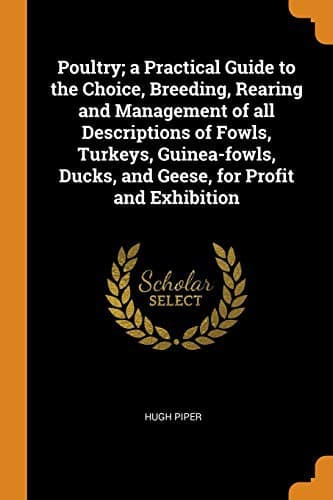
Poultry: A Practical Guide to the Choice, Breeding, Rearing, and Management of all Descriptions of Fowls, Turkeys, Guinea-fowls, Ducks, and Geese, for Profit and Exhibition.Piper, Hugh
Science
Poultry: A Practical Guide to the Choice, Breeding, Rearing, and Management of all Descriptions of Fowls, Turkeys, Guinea-fowls, Ducks, and Geese, for Profit and Exhibition.
Piper, Hugh
Poultry -- Breeding
Rice is not a cheap food. When boiled it absorbs a great quantity of
water and forms a large substance, but, of course, only contains the
original quantity of grain which is of inferior value, especially for
growing chickens, as it consists almost entirely of starch, and does not
contain quite half the amount of flesh-forming materials as oats. When
broken or slightly damaged it may be had much cheaper, and will do as
well as the finest. Boil it for half an hour in skim-milk or water, and
then let it stand in the water till cold, when it will have swollen
greatly, and be so firm that it can be taken out in lumps, and easily
broken into pieces. In addition to its strengthening and fattening
qualities rice is considered to improve the delicacy of the flesh. Fowls
are especially fond of it at first, but soon grow tired of this food. If
mixed with less cloying food, such as bran, they would probably continue
to relish it.
Hempseed is most strengthening during moulting time, and should then be
given freely, especially in cold localities.
Linseed steeped is occasionally given, chiefly to birds intended for
exhibition, to increase the secretion of oil, and give lustre to their
plumage.
Potatoes, from the large quantity of starch they contain, are not good
unmixed, as regular food, but mixed with bran or meal are most conducive
to good condition and laying. They contain a great proportion of
nutriment, comparatively to their bulk and price; and may be
advantageously and profitably given where the number of eggs produced is
of more consequence than their flavour or goodness. A good morning meal
of soft food for a few fowls may be provided daily almost for nothing by
boiling the potato peelings till soft, and mashing them up with enough
bran, slightly scalded, to make a tolerably stiff dry paste. The
peelings will supply as many fowls as there are persons at the dinner
table. A little salt should always be added, and in winter a slight
sprinkling of pepper is good.
"It is indispensable," says Mr. Dickson, "to give the potatoes to fowls
not only in a boiled state, but hot; not so hot, however, as to burn
their mouths, as they are stupid enough to do if permitted. They dislike
cold potatoes, and will not eat them willingly. It is likewise requisite
to break all the potatoes a little, for they will not unfrequently leave
a potato when thrown down unbroken, taking it, probably, for a stone,
since the moment the skin is broken and the white of the interior is
brought into view, they fall upon it greedily. When pieces of raw
potatoes are accidentally in their way, fowls will sometimes eat them,
though they are not fond of these, and it is doubtful whether they are
not injurious."
Mangold-wurtzel, swedes, or other turnips, boiled with a very small
quantity of water, until quite soft, and then thickened with the very
best middlings or meal, is the very best soft food, especially for
Dorkings.
Public-domain text, read in full here on John Shaqi.
Reviews
Reviews
No reviews yet
Be the first to share your thoughts on this work.
Join the Discussion
Join the discussion
Sign in to leave a comment or review.
Sign InorCreate an account