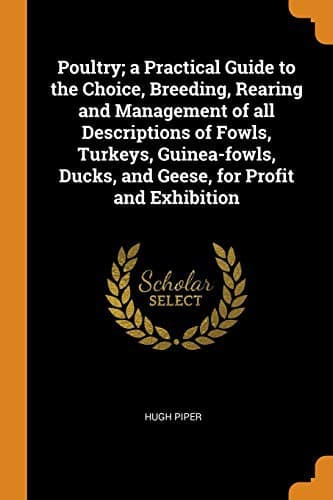
Poultry: A Practical Guide to the Choice, Breeding, Rearing, and Management of all Descriptions of Fowls, Turkeys, Guinea-fowls, Ducks, and Geese, for Profit and Exhibition. — John Shaqi
Poultry: A Practical Guide to the Choice, Breeding, Rearing, and Management of all Descriptions of Fowls, Turkeys, Guinea-fowls, Ducks, and Geese, for Profit and Exhibition.Piper, Hugh
Science
Poultry: A Practical Guide to the Choice, Breeding, Rearing, and Management of all Descriptions of Fowls, Turkeys, Guinea-fowls, Ducks, and Geese, for Profit and Exhibition.
Piper, Hugh
Poultry -- Breeding
Soft food should always be mixed rather dry and _friable_, and not
_porridgy_, for they do not like sticky food, which clings round their
beaks and annoys them, besides often causing diarrhoea. There should
never be enough water in food to cause it to glisten in the light. If
the soft food is mixed boiling hot at night and put in the oven, or
covered with a cloth, it will be warm in the morning, in which state it
should always be given in cold weather.
Fowls have their likes and dislikes as well as human beings, some
preferring one kind of grain to all others, which grain is again
disliked by other fowls. They also grow tired of the same food, and will
thrive all the better for having as much variety of diet as possible,
some little change in the food being made every few days. Fowls should
not be forced or pressed to take food to which they show a dislike. It
is most important to give them chiefly that which they like best, as it
is a rule, with but few exceptions, that what is eaten with most relish
agrees best and is most easily digested; but care must be taken not to
give too much, for one sort of grain being more pleasing to their palate
than another, induces them to eat gluttonously more than is necessary or
healthy. M. Reaumur made many careful experiments upon the feeding of
fowls, and among them found that they were much more easily satisfied
than might be supposed from the greedy voracity which they exhibit when
they are fed, and that the sorts of food most easily digested by them
are those of which they eat the greatest quantity.
No definite scale can be given for the quantity of food which fowls
require, as it must necessarily vary with the different breeds, sizes,
ages, condition, and health of the fowls; and with the seasons of the
year, and the temperature of the season, much more food being necessary
to keep up the proper degree of animal heat in winter than in summer;
and the amount of seeds, insects, vegetables, and other food that they
may pick up in a run of more or less extent. Over-feeding, whether by
excess of quantity or excess of stimulating constituents, is the cause
of the most general diseases, the greater proportion of these diseases,
and of most of the deaths from natural causes among fowls. When fowls
are neither laying well nor moulting, they should not be fed very
abundantly; for in such a state over-feeding, especially with rich food,
may cause them to accumulate too much fat. A fat hen ceases to lay, or
nearly, while an over-fed cock becomes lazy and useless, and may die of
apoplexy.
But half-fed fowls never pay whether kept for the table or to produce
eggs. A fowl cannot get fat or make an egg a day upon little or poor
food. A hen producing eggs will eat nearly twice as much food as at
another time. In cold weather give plenty of dry bread soaked in ale.
Public-domain text, read in full here on John Shaqi.
Reviews
Reviews
No reviews yet
Be the first to share your thoughts on this work.
Join the Discussion
Join the discussion
Sign in to leave a comment or review.
Sign InorCreate an account