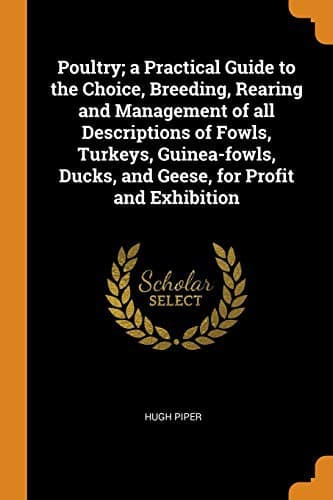
Poultry: A Practical Guide to the Choice, Breeding, Rearing, and Management of all Descriptions of Fowls, Turkeys, Guinea-fowls, Ducks, and Geese, for Profit and Exhibition. — John Shaqi
Poultry: A Practical Guide to the Choice, Breeding, Rearing, and Management of all Descriptions of Fowls, Turkeys, Guinea-fowls, Ducks, and Geese, for Profit and Exhibition.Piper, Hugh
Science
Poultry: A Practical Guide to the Choice, Breeding, Rearing, and Management of all Descriptions of Fowls, Turkeys, Guinea-fowls, Ducks, and Geese, for Profit and Exhibition.
Piper, Hugh
Poultry -- Breeding
Warmth is most essential for promoting laying. A severe frost will
suddenly stop the laying of even the most prolific hens. "When," says M.
Bosc, "it is wished to have eggs during the cold season, even in the
dead of winter, it is necessary to make the fowls roost over an oven, in
a stable, in a shed where many cattle are kept, or to erect a stove in
the fowl-house on purpose. By such methods, the farmers of Ange have
chickens fit for the table in the month of April, a period when they are
only beginning to be hatched in the farms around Paris, although farther
to the south." It is the winter management of fowls that decides the
question of profit or loss, for hens will be sure to pay in the summer,
even if only tolerably attended to. It is thought by many that each hen
can produce only a certain number of eggs; and if such be the case, it
is very advantageous to obtain a portion of them in winter when they are
generally scarce and can be eaten while fresh, instead of having the
whole number produced in the summer, when so many are spoiled from too
long keeping in consequence of more being produced than are required for
use at the time.
When the time for her laying approaches, her comb and wattles change
from their previous dull hue to a bright red, the eye brightens, the
gait becomes more spirited, and sometimes she cackles for three or four
days. After laying her egg on leaving the nest the hen utters a loud
cackling cry, to which the cock often responds in a high-pitched kind of
scream; but some hens after laying leave the nest in silence. Some hens
will lay an egg in three days, some every other day, and others every
day. Hens should not be forced. By unnaturally forcing a fowl with
stimulating food, and more particularly with hempseed and tallow
greaves, to lay in two years or so the eggs that should have been the
produce of several, the hen becomes prematurely old and diseased; and it
is reasonable to suppose that the eggs are not so good as they would
have been if nature had been left to run its own course. The eggs ought
to be taken from the nest every afternoon when no more may be expected
to be laid; for if left in the nest, the heat of the hens when laying
next day will tend to corrupt them.
Public-domain text, read in full here on John Shaqi.
Reviews
Reviews
No reviews yet
Be the first to share your thoughts on this work.
Join the Discussion
Join the discussion
Sign in to leave a comment or review.
Sign InorCreate an account