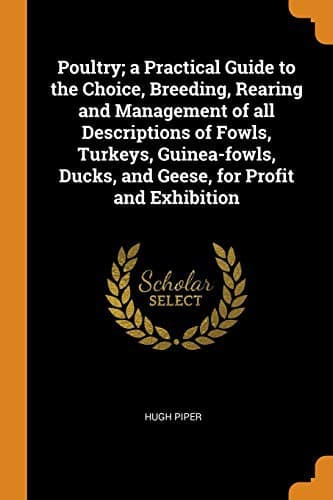
Poultry: A Practical Guide to the Choice, Breeding, Rearing, and Management of all Descriptions of Fowls, Turkeys, Guinea-fowls, Ducks, and Geese, for Profit and Exhibition. — John Shaqi
Poultry: A Practical Guide to the Choice, Breeding, Rearing, and Management of all Descriptions of Fowls, Turkeys, Guinea-fowls, Ducks, and Geese, for Profit and Exhibition.Piper, Hugh
Science
Poultry: A Practical Guide to the Choice, Breeding, Rearing, and Management of all Descriptions of Fowls, Turkeys, Guinea-fowls, Ducks, and Geese, for Profit and Exhibition.
Piper, Hugh
Poultry -- Breeding
An egg exposed to the air is continually losing a portion of its
moisture, the place of which is filled by the entrance of air, and the
egg consequently becomes stale, and after a time putrid. M. Reaumur made
many experiments in preserving eggs, and found that, by coating them
with varnish, it was impossible to distinguish those which had been kept
for a year from those newly laid; but varnish, though not expensive, is
not always to be had in country places, and it also remained on the eggs
placed under a hen and impeded the hatching, while in boiling them, the
varnish, not being soluble in hot water, prevented them from being
properly cooked. He tried other substances, and found that fat or
grease, such as suet, lard, dripping, butter, and oil, were well adapted
for the purpose, the best of these being a mixture of mutton and beef
suet thoroughly melted together over a slow fire, and strained through
a linen cloth into an earthen pan. It is only requisite, he says, to
take a piece of the fat or butter about the size of a pea on the end of
the finger, and rub it all over the shell, by passing and repassing the
finger so that no part be left untouched; the transpiration of matter
from the egg being as effectually stopped by the thinnest layer of fat
or grease as by a thick coating, so that no part of the shell be left
ungreased, or the tip of the finger may be dipped into oil and passed
over the shell in the same manner. If it is desired that the eggs should
look clean, they may be afterwards wiped with a towel, for sufficient
grease or oil enters the pores of the shell to prevent all transpiration
without its being necessary that any should be left to fill up the
spaces between the pores. They can be boiled as usual without rubbing
off the fat, as it will melt in the hot water, and when taken out of the
water the little grease that is left upon the egg is easily wiped off
with a napkin.
Eggs preserved in this manner can also be used for hatching, as the fat
easily melts away by the heat of the hen; and by this means the eggs of
foreign fowls might be carried to a distance, hatched, and naturalised
in this and other countries. The French also find that a mixture of
melted beeswax and olive oil is an excellent preservative.
Public-domain text, read in full here on John Shaqi.
Reviews
Reviews
No reviews yet
Be the first to share your thoughts on this work.
Join the Discussion
Join the discussion
Sign in to leave a comment or review.
Sign InorCreate an account