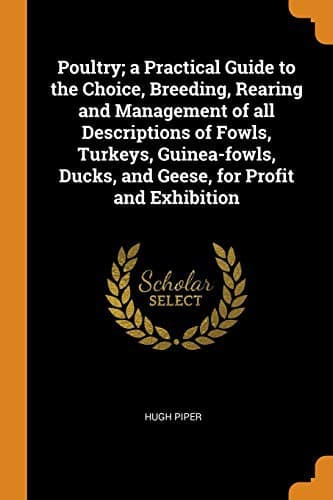
Poultry: A Practical Guide to the Choice, Breeding, Rearing, and Management of all Descriptions of Fowls, Turkeys, Guinea-fowls, Ducks, and Geese, for Profit and Exhibition.Piper, Hugh
Science
Poultry: A Practical Guide to the Choice, Breeding, Rearing, and Management of all Descriptions of Fowls, Turkeys, Guinea-fowls, Ducks, and Geese, for Profit and Exhibition.
Piper, Hugh
Poultry -- Breeding
In selecting eggs for setting, choose the freshest, those of moderate
size, well-shaped, and having the air-vessel distinctly visible, either
in the centre of the top of the egg, or slightly to the side, when the
egg is held between the eye and a lighted candle, in a darkened room.
Reject very small eggs, which generally have no yolk, those that are
ill-shaped, and those of equal thickness at both ends, which latter is
the usual shape of eggs with double yolks. These should be avoided, as
they are apt generally to prove unfertile, or produce monstrosities.
It has been stated that the sex of the embryo chicken can be ascertained
by the position of the air-vessel; that if it be on the top the egg will
produce a cockerel, and if on the side a pullet; but there is no proof
of the truth of this, and, notwithstanding such assertions, it appears
to be impossible to foretell the sex of the chick, from the shape of the
egg or in any other way.
In selecting eggs for the purpose of producing fowls that are to be kept
for laying only, being non-sitters, choose eggs only from those hens
that are prolific layers, for prolific laying is often as characteristic
of some fowls of a breed as it is of the particular breeds, and by
careful selection this faculty, like others, may be further developed,
or continued if already fully developed.
If carefully packed, eggs for setting may be carried great
distances--hundreds and even thousands of miles--without injury;
vibration and even moderate shaking, and very considerable changes of
temperature, producing no ill effect upon the germ. The chief point is
to prevent the escape of moisture by evaporation, and consequent
admission of air. A hamper travels with less vibration than a box, and
is therefore preferable, especially for a long journey. They should be
packed in hay, by which they will be preserved from breakage much better
than by being packed in short, close material like bran, chaff, oats, or
sawdust; these being shaken into smaller space by the vibration of
travelling, the eggs often strike and crack each other. The hamper or
box should be large enough to admit of some soft, yielding packing
material being placed all round the eggs. The bottom should be first
covered with a good layer of hay, straw, or moss. It is a good plan to
roll each egg separately in hay or moss, fastened with a little wool or
worsted. They should be covered with well-rubbed straw, pressed down
carefully and gently. The lid of the hamper should be sewed on tightly
all round, or in three or four places at least. If a box is used, the
lid should be fastened by cords or screws, but not with nails, as the
hammering would probably destroy the germ of the egg.
Public-domain text, read in full here on John Shaqi.
Reviews
Reviews
No reviews yet
Be the first to share your thoughts on this work.
Join the Discussion
Join the discussion
Sign in to leave a comment or review.
Sign InorCreate an account