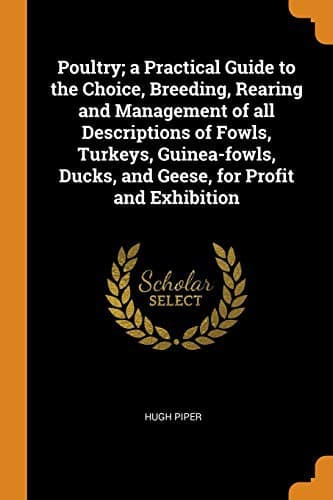
Poultry: A Practical Guide to the Choice, Breeding, Rearing, and Management of all Descriptions of Fowls, Turkeys, Guinea-fowls, Ducks, and Geese, for Profit and Exhibition.Piper, Hugh
Science
Poultry: A Practical Guide to the Choice, Breeding, Rearing, and Management of all Descriptions of Fowls, Turkeys, Guinea-fowls, Ducks, and Geese, for Profit and Exhibition.
Piper, Hugh
Poultry -- Breeding
In procuring eggs for hatching, be sure that the parent birds are of
mature age, but not too old, well-shaped, vigorous, and in perfect
health; that one cock is kept to every six or seven hens; and that they
are well fed and attended to. Have a steady broody hen ready to take the
eggs.
CHAPTER VI.
THE SITTING HEN.
All hens that are inclined to sit should be allowed to hatch and bring
up one brood of chickens a year; for, if altogether restrained from
sitting, a hen suffers much in moulting, and is restless and excited for
the remainder of the season. It is unnatural, and therefore must be
injurious. The period of incubation gives her rest from producing eggs.
The hen that is always stimulated to produce eggs, and not allowed to
vary that process by hatching and bringing up a young brood, must
ultimately suffer from this constant drain upon her system, and the eggs
are said to be unwholesome.
But hens frequently wish to sit when it is not convenient, or in autumn
or winter, when it is not advisable, unless very late or early chickens
are desired, and every attention can be given to them. To check this
desire, the old-fashioned plan with farmers' wives, of plunging the
broody hen into cold water, and keeping her there for some minutes, was
not only a cruel practice, but often failed to effect its object, and
must naturally always have caused ultimate disease in the poor bird.
When it is absolutely necessary to check the desire of a hen to sit, the
best plan is to let her sit on some nest-eggs for a week, then remove
and coop her for a few days, away from the place where she made her
nest, low diet, as boiled potatoes and boiled rice, and water being
placed near; meanwhile taking away the eggs and destroying the nest,
and, not finding it on her return, she will generally not seek for
another, unless she is a Cochin, or the desire exceedingly strong.
When a hen wishes to sit, she utters a peculiar cluck, ruffles her
feathers, wanders about, searches obscure corners and recesses, is very
fidgety, feverishly hot, impatient, anxiously restless, and seeks for a
nest. Highly-fed hens feel this desire sooner than those that are not so
highly fed. A hen may be induced to sit at any season, by confining her
in a dark room in a covered basket, only large enough to contain her
nest, keeping her warm, and feeding her on stimulating food, such as
bread steeped in ale, a little raw liver or fresh meat chopped small,
and potatoes mashed warm with milk and oatmeal.
Public-domain text, read in full here on John Shaqi.
Reviews
Reviews
No reviews yet
Be the first to share your thoughts on this work.
Join the Discussion
Join the discussion
Sign in to leave a comment or review.
Sign InorCreate an account