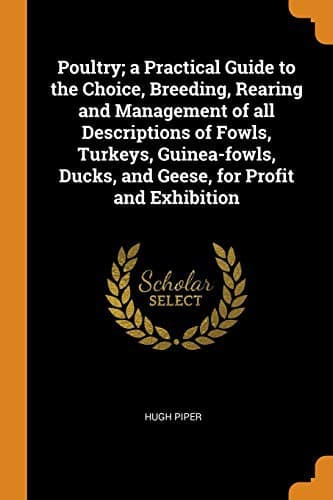
Poultry: A Practical Guide to the Choice, Breeding, Rearing, and Management of all Descriptions of Fowls, Turkeys, Guinea-fowls, Ducks, and Geese, for Profit and Exhibition.Piper, Hugh
Science
Poultry: A Practical Guide to the Choice, Breeding, Rearing, and Management of all Descriptions of Fowls, Turkeys, Guinea-fowls, Ducks, and Geese, for Profit and Exhibition.
Piper, Hugh
Poultry -- Breeding
In breeding birds for exhibition the number of hens to one cock should
not exceed four or five, but if only two or three hens of the breed are
possessed, the proper number of his harem should be made up by the
addition of hens of another breed, those being chosen whose eggs are
easily known from the others.
If it is intended to rear the chickens for exhibition at the June,
July, or August shows, the earlier they are hatched the better, and
therefore a sitting should be made in January, if you have a young,
healthy hen broody. Set her on the ground in a warm, sheltered, and
quiet place, perfectly secure from rain, or from any flow of snow water.
Feed her well, and keep water and small quantities of food constantly
within her reach, so that she may not be tempted to leave the nest in
search of food; for the eggs soon chill in winter. Mix the best oatmeal
with hot water, and give it to her warm twice a day. A few grains of
hempseed as a stimulant may be given in the middle of the day. The great
difficulty to overcome in rearing early chickens is to sustain their
vital powers during the very long winter nights, when they are for so
many hours without food, the only substitute for which is warmth, and
this can only be well got from the hen. Consequently a young
Cochin-China with plenty of "fluff" will provide most warmth. The hen
should not be set on more than five, or at most seven eggs; for if she
has more, although she may sufficiently cover the chickens while very
small, she will not be able to do so when they grow larger, and the
outer ones will be chilled unless they manage to push themselves into
the inside places, and then the displaced chickens being warm are sure
to get more chilled than the others; and so the greater number of the
brood, even if they survive, will probably be weakly, puny things,
through the greedy desire to rear so many, while if she hatch but five
chickens she will probably rear four. The hen should be cooped until the
chickens are at least ten weeks old, and covered up at night with
matting, sacking, or a piece of carpet.
Public-domain text, read in full here on John Shaqi.
Reviews
Reviews
No reviews yet
Be the first to share your thoughts on this work.
Elsewhere in the archive
Join the Discussion
Join the discussion
Sign in to leave a comment or review.
Sign InorCreate an account