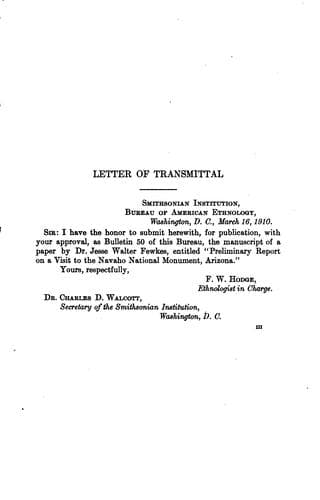
Preliminary report on a visit to the Navaho National Monument, ArizonaFewkes, Jesse Walter
History
Preliminary report on a visit to the Navaho National Monument, Arizona
Fewkes, Jesse Walter
Arizona -- Antiquities; Cliff-dwellings -- Arizona; Navajo National Monument (Ariz.)
The architecture of the ruins on the Little Colorado near Black Falls
resembles that of the open ruins, especially Ruin A, and those near
the road from Bekishibito to Marsh pass. While great weight can not be
given to this resemblance, since we find much uniformity in stone ruins
everywhere in the Southwest, it is interesting to take in connection
with this fact the close likeness in minor objects from the Laguna
Creek ruins and the Black Falls cluster. The prevailing ware from both
is the gray pottery with black geometrical ornamentation and red ware
with black or brown decoration. The red ware and the yellow ware, so
abundant higher up the river, are not the prevailing kinds. The pottery
of the Black Falls ruins is essentially the same type as that of the
San Juan and its tributaries.
[18] Mr. Stephen Janus, agent of the Northwestern Navaho, to whom the
author is indebted for many kindnesses, joined him at Tuba and made the
trip to Marsh pass and the neighboring ruins with his party.
[19] The presence of excellent traders’ stores at Tuba and Red Lake
renders it unnecessary to carry groceries or fodder from Flagstaff.
[20] Spanish: _vaca_, “cow”; Navaho: _shi_, “her”; _to_, “water”.
MAJOR ANTIQUITIES
RUIN A
The first ruin of considerable size that was visited is situated to
the left of and somewhat distant from the road, a few miles west and
south of Marsh pass. As this ruin (pl. 4)[21] stands on an elevation,
it is visible for a considerable distance across the valley, especially
to one approaching it from the southwest. The standing walls rise in
places to a height of 10 feet, showing indications of two stories, some
of the rafters in places still projecting beyond the face of the wall.
The two walls highest and most prominent are parallel, inclosing a long
room or court; in one place a break has been made through these walls,
as appears in the illustration. The remnants or foundations of other
walls back of these show that ruin A was formerly very much larger than
the walls now standing would indicate.
The walls are composed of roughly laid masonry, bearing evidences on
the inside of adobe plastering. An exceptional feature is the large
number of the component stones decorated on their outer faces with
deeply incised geometrical figures, apparently traced with some pointed
implement.[22]
Comparison of the architecture of this ruin with that of the Black
Falls ruin here figured (pl. 3) shows a resemblance which is more
than superficial, in the elevated site, character of the masonry, and
general ground plan; and comparison of its walls with those of Old
Walpi shows a similar likeness, which is instructive so far as it goes.
This is the only large ruin visited that is characterized by high
standing walls on top of an eminence, but Navaho guides said they were
familiar with others in this neighborhood similar in structure and
situation.
Public-domain text, read in full here on John Shaqi.
Reviews
Reviews
No reviews yet
Be the first to share your thoughts on this work.
Join the Discussion
Join the discussion
Sign in to leave a comment or review.
Sign InorCreate an account