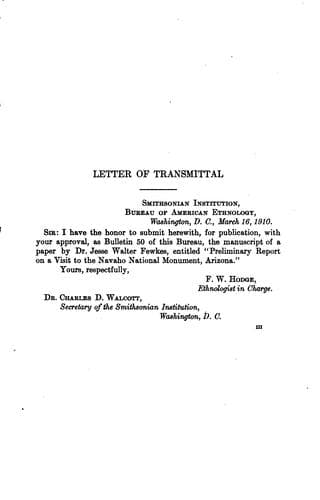
Preliminary report on a visit to the Navaho National Monument, ArizonaFewkes, Jesse Walter
History
Preliminary report on a visit to the Navaho National Monument, Arizona
Fewkes, Jesse Walter
Arizona -- Antiquities; Cliff-dwellings -- Arizona; Navajo National Monument (Ariz.)
While as a rule there is great similarity in secular rooms in different
culture areas of the Southwest, the more archaic ceremonial rooms of
these regions vary considerably. The rooms ordinarily called kivas
are of two distinct types, circular and rectangular. There are two
kinds of circular kivas,[38] one having pilasters and banquettes to
support the roof, the other without pilasters, apparently roofless,
but surrounded by high walls as if for the purpose of obscuring the
view from neighboring plazas. The circular kivas commonly do not
form a part of the house mass, being separated some distance from
the secular rooms. From all that can be learned it appears that the
round kiva is an ancient type, its position in the rear of the cave in
such cliff-dwellings as Spruce-tree House and Cliff Palace indicating
that this form is as old as the building itself. The circular type,
with pilasters, is confined wholly to the eastern region, having been
reported from the Mesa Verde, the San Juan and many of its tributaries,
Chaco canyon, and certain ruins west of the Rio Grande. Circular kivas
somewhat modified are found also in many of the Rio Grande pueblos,
where they are still in use. A subtype of circular kivas without
pilasters but provided each with one large banquette is the common
form of circular ceremonial room in the Navaho National Monument and
the Canyon de Chelly. The modern representative of this subtype is
the Snake kiva of the Hopi, which has become rectangular, the large
banquette (_tuwibi_, pl. 14) being modified into the “spectators,” or
elevated surface of the floor.
The corresponding ceremonial rooms at Zuñi and in the prehistoric Hopi
pueblos are rectangular in form and of simpler architecture. Similarly
shaped ceremonial rooms, not subterranean, are still in use in modern
Hopi pueblos. As a good example of this archaic form of ceremonial room
at Walpi may be mentioned that in which the Flute altar is erected and
in which the Flute secret rites are performed.[39] This ancestral room
of the clan is a rectangular chamber forming part of the second floor,
and is entered from one side. The Flute clans came from a pueblo,
now a ruin, in the north, but after union with the Ala, who lived
at Tokónabi, they settled at the Snake pueblo, Walpi. So it may be
supposed that their ancestors also had no special kiva, but celebrated
their secret rites in an ordinary house.
The fraternity of Sun priests likewise erect their altar and perform
their secret ceremonies in a room, not in a kiva; so do the Kalektaka,
or warriors. None of these rooms is commonly regarded or enumerated as
a kiva, but such chambers are believed to be the direct representatives
of the ceremonial rooms built above ground as a part of the house, in
the manner more characteristic of ceremonial rooms in Arizona ruins.
Public-domain text, read in full here on John Shaqi.
Reviews
Reviews
No reviews yet
Be the first to share your thoughts on this work.
Join the Discussion
Join the discussion
Sign in to leave a comment or review.
Sign InorCreate an account