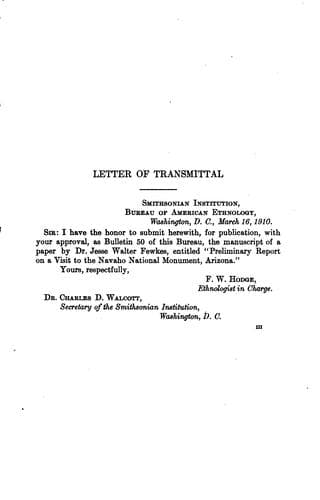
Preliminary report on a visit to the Navaho National Monument, Arizona — John Shaqi
Preliminary report on a visit to the Navaho National Monument, ArizonaFewkes, Jesse Walter
History
Preliminary report on a visit to the Navaho National Monument, Arizona
Fewkes, Jesse Walter
Arizona -- Antiquities; Cliff-dwellings -- Arizona; Navajo National Monument (Ariz.)
The ruins in the Navaho Monument have ceremonial rooms allied on one
side to the kivas of the San Juan region, and on the other to rooms in
the Little Colorado ruins that may have been built for ceremonial use.
The latter are constructed above ground, inclosed by other houses, and
are rectangular in shape, with lateral doorways. Some of these rooms,
as at Betatakin, contain each a fire screen and a fire-hole, as in a
circular kiva, the ventilator being replaced by a lateral doorway. It
is possible that when the Snake people inhabited their northern homes,
before they came to Walpi, their ceremonial rooms were not built, as
at present, partly underground, and placed at a distance from the
secular houses. The ceremonial rooms of this clan and of immediate
relatives when living at Tokónabi or in the Navaho Monument region may
have resembled those of the Black Falls cluster of ruins.[40] Their
subterranean position and separation from other rooms may be regarded
as modifications due to foreign influences after the clan arrived at
Walpi.[41]
[Illustration:
BUREAU OF AMERICAN ETHNOLOGY BULLETIN 50 PLATE 15
_a._ FOOD BOWL
Cat. No. 257781. Diameter, 4½ inches.
_b._ CLAY DISK WITH PERFORATED BORDER
Cat. No. 258330. Diameter, 5¼ inches.
_c._ DIPPER
Cat. No. 257779. Height, 4½ inches.
_d._ FOOD-BOWL WITH HANDLE
Cat. No. 257780. Diameter, 6 inches.
POTTERY FROM NAVAHO NATIONAL MONUMENT]
The sunken or subterranean situation of the ceremonial assembly room,
or kiva, of the Pueblo region is an architectural survival of a people
whose secular and ceremonial rooms were subterranean. This feature may
not be autochthonous in this area, or limited to it geographically,
having probably been derived from people of kindred culture of the West
coast, as pointed out by Mr. Ernest Sarfert’s argument on this point,
which would seem to be conclusive if subterranean kivas could be found
in the Gila and Little Colorado regions.[42]
The forms of pueblo kivas, circular or rectangular, are not derived
one from the other, but suggest different geographical origins. The
circular form, confined to the eastern Pueblo area, bears evidence of
having been derived from the culture of a people inhabiting a forested
region; while the rectangular form strongly suggests a people with a
treeless habitat. Both circular and rectangular subterranean assembly
rooms existed in aboriginal California in historic and prehistoric
times. The archaic or prehistoric culture of the Pueblo region is
closely related to that of the West coast in other particulars also,
that do not concern the subject of this article.
Public-domain text, read in full here on John Shaqi.
Reviews
Reviews
No reviews yet
Be the first to share your thoughts on this work.
Join the Discussion
Join the discussion
Sign in to leave a comment or review.
Sign InorCreate an account