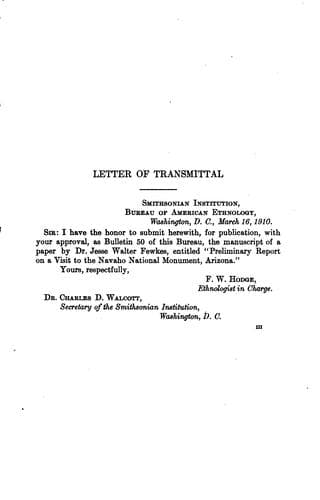
Preliminary report on a visit to the Navaho National Monument, ArizonaFewkes, Jesse Walter
History
Preliminary report on a visit to the Navaho National Monument, Arizona
Fewkes, Jesse Walter
Arizona -- Antiquities; Cliff-dwellings -- Arizona; Navajo National Monument (Ariz.)
References to the northern ruins occur frequently in Hopi legends of
the Snake and Flute clans, and even accounts of the great natural
bridges lately seen for the first time by white people were given years
ago by Hopi familiar with legends of these families. The writer heard
the Hopi tell of their former homes among the “high rocks” in the north
and at Navaho mountain, fifteen years ago, at which time they offered
to guide him to them. The stories of the great cave ruins to the north
were heard even earlier from the lips of the Hopi priests by another
observer. Mr. A. M. Stephen, the pioneer in Hopi studies, informed the
writer that he had learned of great ruins in the north as far back as
1885, and Mr. Cosmos Mindeleff, aided by Mr. Stephen, published the
names of the clans which, according to the Hopi, inhabited them.
[Illustration:
BUREAU OF AMERICAN ETHNOLOGY BULLETIN 50 PLATE 3
_a._ FROM THE SOUTH
_b._ FROM THE NORTH
WUKÓKI RUIN AT BLACK FALLS]
Victor Mindeleff[3] summarizes the Hopi traditions concerning Tokónabi
still preserved by the Horn and Flute clans of Walpi:
The Horn people, to which the Lenbaki [Flute] belonged, have a legend
of coming from a mountain range in the east.
Its peaks were always snow covered, and the trees were always green.
From the hillside the plains were seen, over which roamed the deer,
the antelope, and the bison, feeding on never-failing grasses.
[Possibly the Horn people were so called from an ancient home where
horned animals abounded.] Twining through these plains were streams of
bright water, beautiful to look upon. A place where none but those who
were of our people ever gained access.
This description suggests some region of the headwaters of the Rio
Grande. Like the Snake people, they tell of a protracted migration,
not of continuous travel, for they remained for many seasons in one
place, where they would plant and build permanent houses. One of
these halting places is described as a canyon with high, steep walls,
in which was a flowing stream; this, it is said, was the Tségi (the
Navajo name for Canyon de Chelly).[4] Here they built a large house in
a cavernous recess, high up in the canyon wall. They tell of devoting
two years to ladder making and cutting and pecking shallow holes up
the steep rocky side by which to mount to the cavern, and three years
more were employed in building the house....
Public-domain text, read in full here on John Shaqi.
Reviews
Reviews
No reviews yet
Be the first to share your thoughts on this work.
Join the Discussion
Join the discussion
Sign in to leave a comment or review.
Sign InorCreate an account