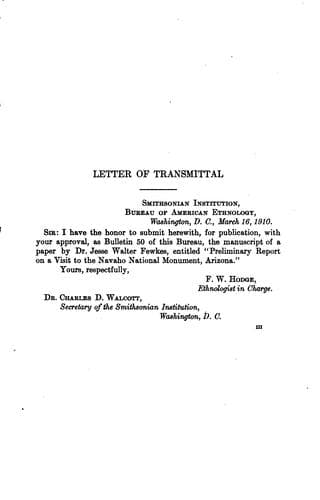
Preliminary report on a visit to the Navaho National Monument, ArizonaFewkes, Jesse Walter
History
Preliminary report on a visit to the Navaho National Monument, Arizona
Fewkes, Jesse Walter
Arizona -- Antiquities; Cliff-dwellings -- Arizona; Navajo National Monument (Ariz.)
The legend goes on to tell that after they had lived there for a long
time a stranger happened to stray in their vicinity, who proved to be
a Hopituh [Hopi], and said that he lived in the south. After some stay
he left and was accompanied by a party of the “Horn” [clan], who were
to visit the land occupied by their kindred Hopituh and return with an
account of them; but they never came back. After waiting a long time
another band was sent, who returned and said that the first emissaries
had found wives and had built houses on the brink of a beautiful
canyon, not far from the other Hopituh dwellings. After this many of
the Horns grew dissatisfied with their cavern home, dissensions arose,
they left their home and finally they reached Tusayan.
The early legends of the Snake clans tell how bags containing their
ancestors were dropped from a rainbow in the neighborhood of Navaho
mountain. They recount how they built a pentagonal home and how one of
their young men married a Snake girl who gave birth to reptiles, which
bit the children and compelled the people to migrate. They left their
canyon homes and went southward, building houses at the stopping-places
all the way from Navaho mountain to Walpi. Some of these houses,
probably referring to their _kivas_ and _kihus_, legends declare, were
round[5] and others square.
Some of the ruins here mentioned have been known to white men for many
years. There is evidence that they have been repeatedly visited by
soldiers, prospectors, and relic hunters. The earliest white visitor of
whom there is any record was Lieutenant Bell, of the 2d (?) Infantry,
U. S. A.,[6] whose name, with the date 1859, is still to be seen cut on
a stone in a wall of ruin A.
A few years ago information was obtained from Navaho by Richard and
John Wetherill of the existence of some of the large cliff-houses
on Laguna creek and its branches; the latter has guided several
parties to them. Among other visitors in 1909 may be mentioned Dr.
Edgar L. Hewett, director of the School of American Archæology of the
Archæological Institute of America. A party[7] from the University of
Utah, under direction of Prof. Byron Cummings, has dug extensively in
the ruins and obtained a considerable collection.
Public-domain text, read in full here on John Shaqi.
Reviews
Reviews
No reviews yet
Be the first to share your thoughts on this work.
Join the Discussion
Join the discussion
Sign in to leave a comment or review.
Sign InorCreate an account